Home Blog Page 42

10+ Summer Travel Life Hacks To Make Your Life Easier

We all get excited for summer, we can start planning road trips and family vacations.  Along with it, however, comes the dreaded chores of organising and packing.  Here are a few life hacks that will help you with the not so fun travel times.


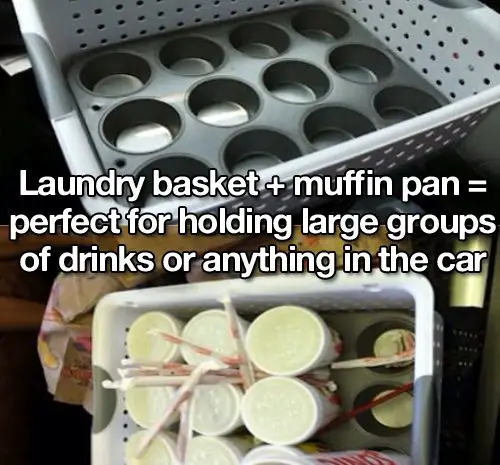
muffin tray for drinks
Seriously For Real

Use a laundry basket and muffin tray as a large drinks holder.

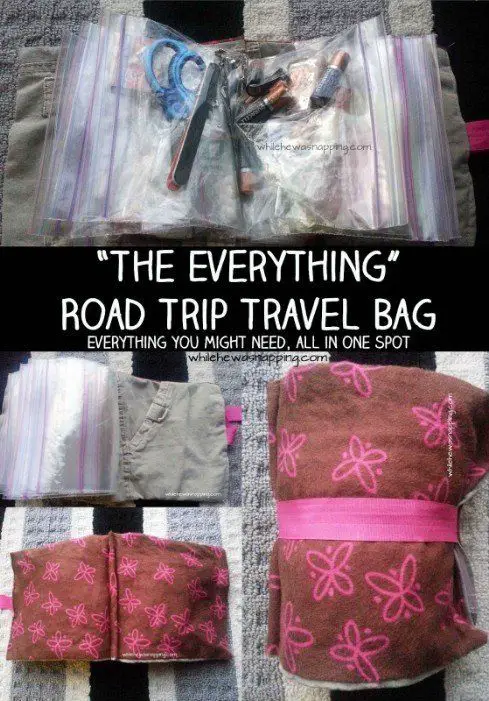
road trip travel bag
While He Was Napping

Make your own nifty travel bag to keep all of your road trip essentials.

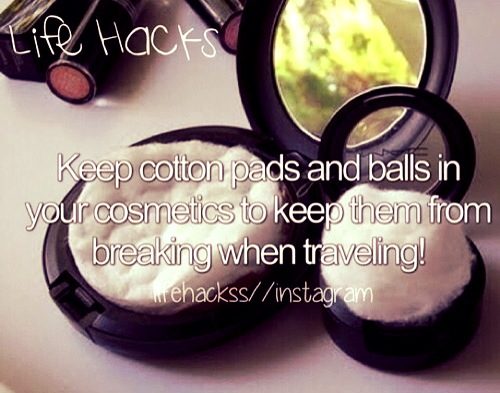
keep cotton pads and balls

Keep cotton pads or balls in your makeup cases to keep them from breaking apart when travelling.

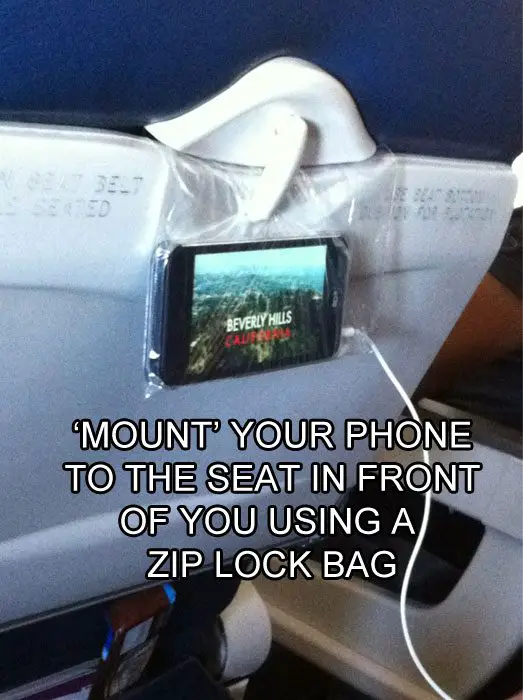
mount your phone on the seat
Twisted Sifter

Stick your phone in a zip lock bag to make the perfect holder for your movies and series during a road trip.

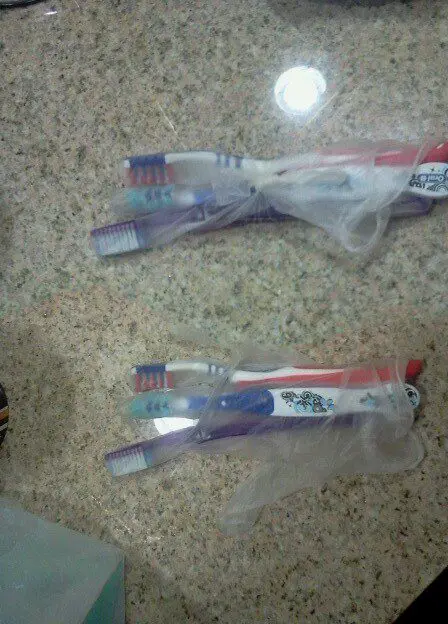
disposable gloves for toothbrush

Use a disposable glove to keep your toothbrushes clean. Put toothbrushes in the middle 3 fingers. Use the pinkie and thumb to tie the 3 together.

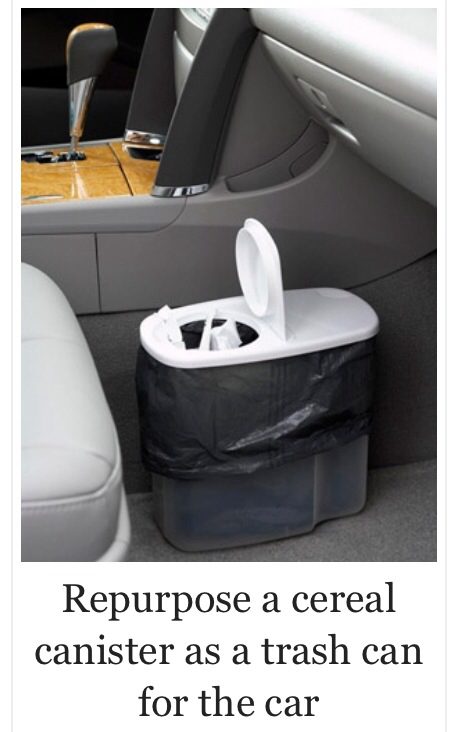
car trash can


A cereal container with a plastic bag makes a great trash can for your car.

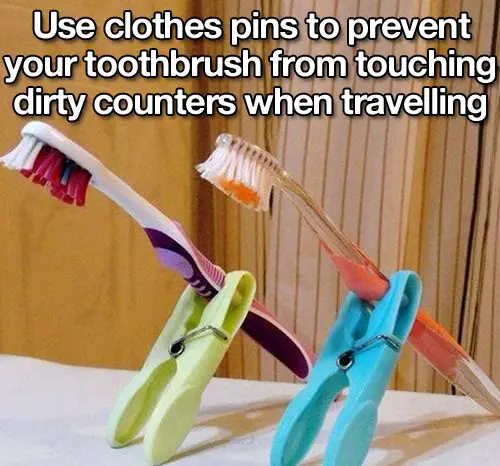
toothbrush clothes peg
Seriously For Real

Take some clothes pegs with you to prevent your toothbrush from touching any potentially dirty surfaces.

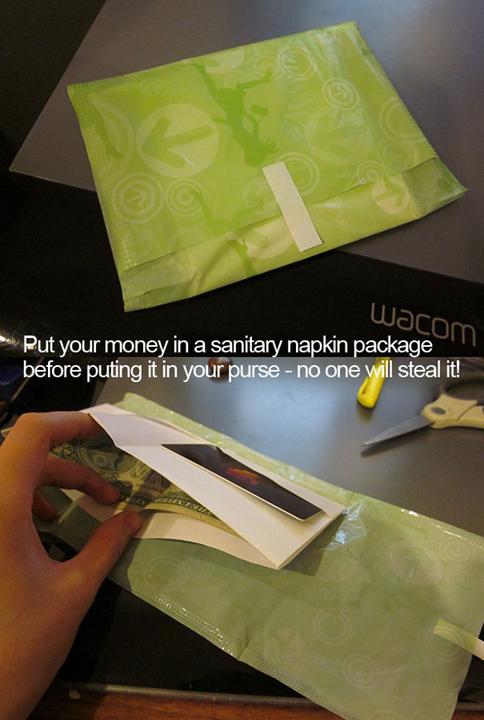
money in a sanitary bag
Just Imagine

No-one opens sanitary bags to look for money, its the perfect hiding place.

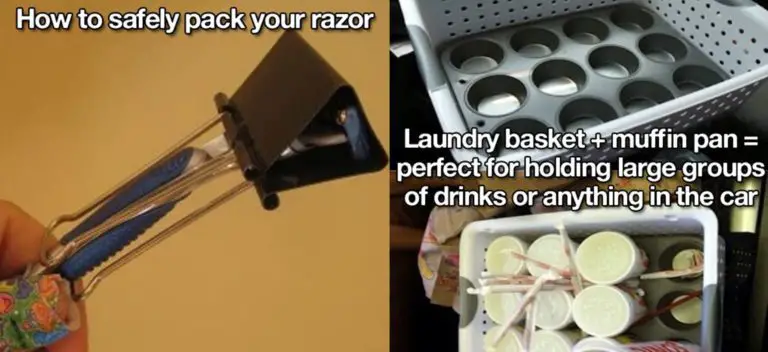
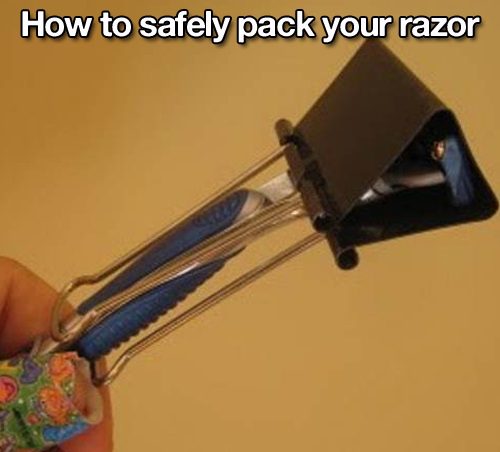
how to pack a razor
Seriously For Real

If you’ve lost the plastic guard for your razor, an office clip makes a great replacement to help with your razor travels.

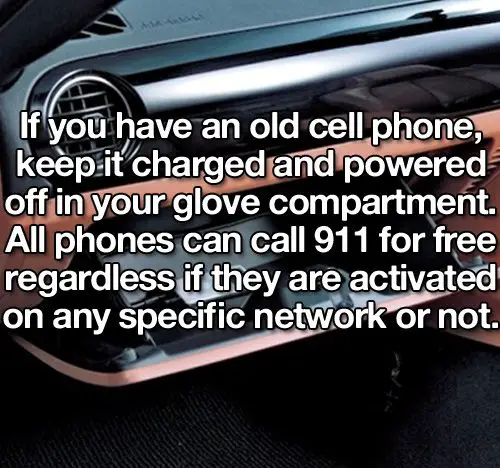
cellphone for emergencies
Seriously For Real

Keep and old cell phone in your cars glove box in case of emergencies, you’ll be grateful one day when you need it. Even better would be to keep it with a charger or power bank.

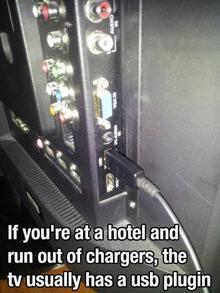
hotel charger hack
Daily Dawdle

Most modern TVs have USB ports on the back of them, use them to charge your phones or gadgets when you don’t have the right adapters.

If you don’t plan on making travel plans any time soon then read our list of 15 Brilliant Tricks To Make Your Life Easier instead.

Do you have any travel hacks, tips or tricks? Let us know in the comments section below. We are always looking for new ways to make life easier.


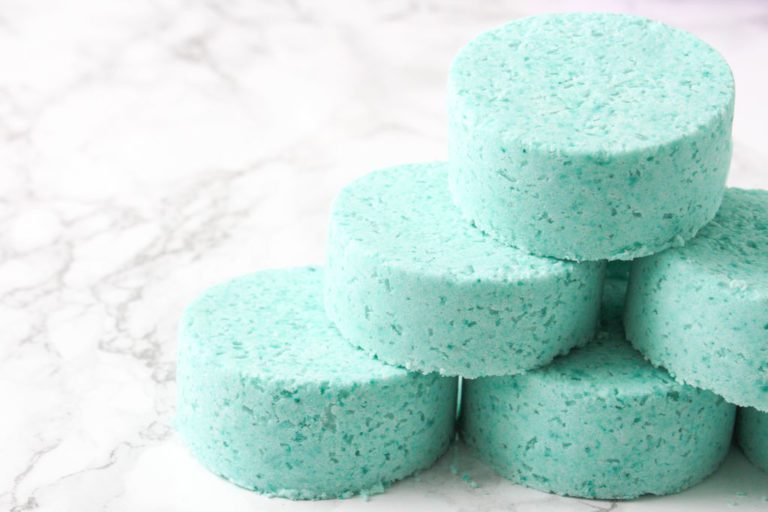
DIY Moisturising Bath Bombs, Perfect For Dry Skin

If you’ve discovered the magic of baths and bath bombs then you’ve probably discovered they can also be quite expensive! It may be time to start making your own. They also make a lovely gift, place a couple on a homemade mini pallet coaster and wrap it up in cellophane for a thoughtful and inexpensive homemade gift. You could also pair them up with our homemade exfoliating coffee and brown sugar body scrub.

Making bath bombs is actually a super easy process! There are definitely some possible pit falls along the way, but we’ll guide you through the process and let you know when you need to do things a certain way. This moisturizing recipe is extra easy to make because we’re using more oil than water.

This bath bomb recipe produces a slightly fizzy and super moisturizing soak for your bath water!

What You Need To Make 8 Moisturising Bath Bombs

  • Slightly Less than 1 cup Baking Soda – Buy Now
  • 1/2 cup Citric Acid – Buy Now
  • 3/4 cup Corn Starch – Buy Now
  • Heaping 1/2 cup Epsom Salts – Buy Now
  • 1 Tablespoon Water
  • 3 Tablespoons Oil of Choice (I used avocado) – Buy Now
  • 25-50 Drops of Essential Oil* – Buy Now
  • Food Coloring (2-5 drops, depending on how intense you want the color!) – Buy Now

Important note regarding essential oils: oils like clove, cinnamon, tea tree, eucalyptus, lemongrass, and peppermint can cause a burning sensation and a red rash if you use too much. (Especially if you have sensitive skin) On the upside, these oils also smell VERY strongly, so you don’t have to use as much.

This recipe will make roughly 20 oz worth of bath bombs – around 8 bath bombs that weigh between 2 and 3 oz.

How To Make The Bath Bombs

The first thing you want to do it measure out all your dry ingredients into a large bowl. (Baking soda, cornstarch, epsom salts, citric acid. Once you’ve measured them out, mix them together with your whisk for a minute or so. You want all the ingredients to be well incorporated.

Now you’ll want to mix the wet ingredients together in a small bowl. Add in the water, oil, essential oils and food coloring. Mix this together and check the color of the mix – if it looks too light add a little more food coloring if you want!
adding the wet and dry ingredients

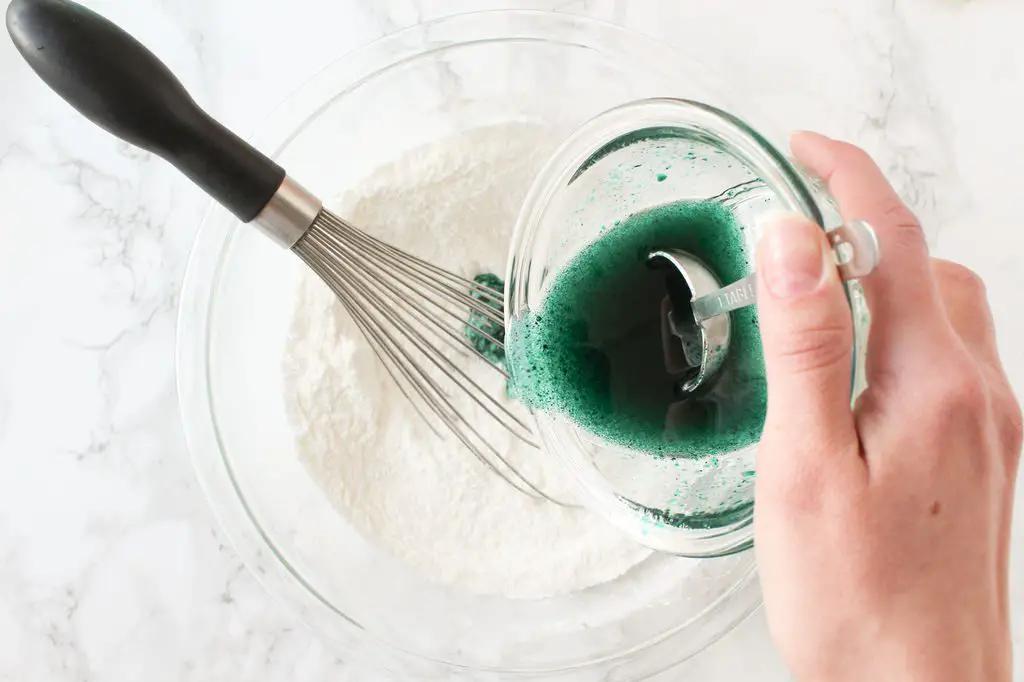
This is the step where you have to be careful! Pour the wet into the dry, just a little bit at a time. Mix with the whisk immediately to stop any bubbling that may occur. If you let the mix bubble now, you won’t get lots of fizziness when you put the bath bombs in your bath. Keep pouring and mixing until all the wet ingredients are mixed in. Break up any big clumps with the whisk as you go – they may have pockets of color or a certain ingredient inside!
test the bath bomb mixture

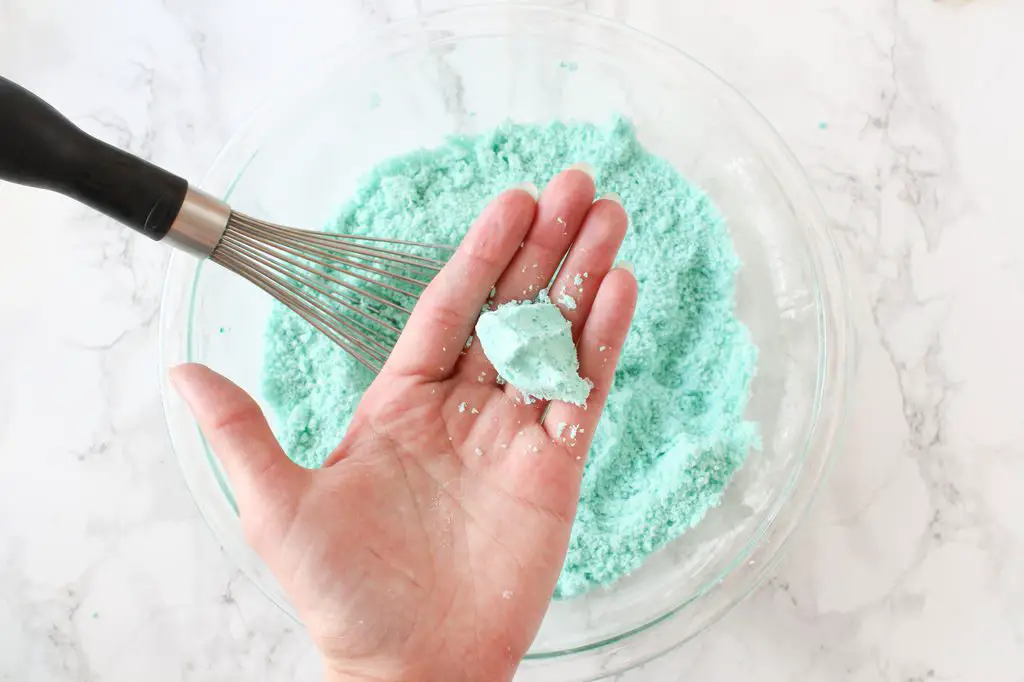
Now we need to test the mix and see if it holds together! Grab a small bit and press it together in your hands. If it sticks together and smoothes out, you have enough moisture! If the mix is dry and crumbly and doesn’t want to stick to itself, you will need to add more water. Add it with a spray bottle if possible. If not, just add small amounts and mix well after.
filling and packing the mould

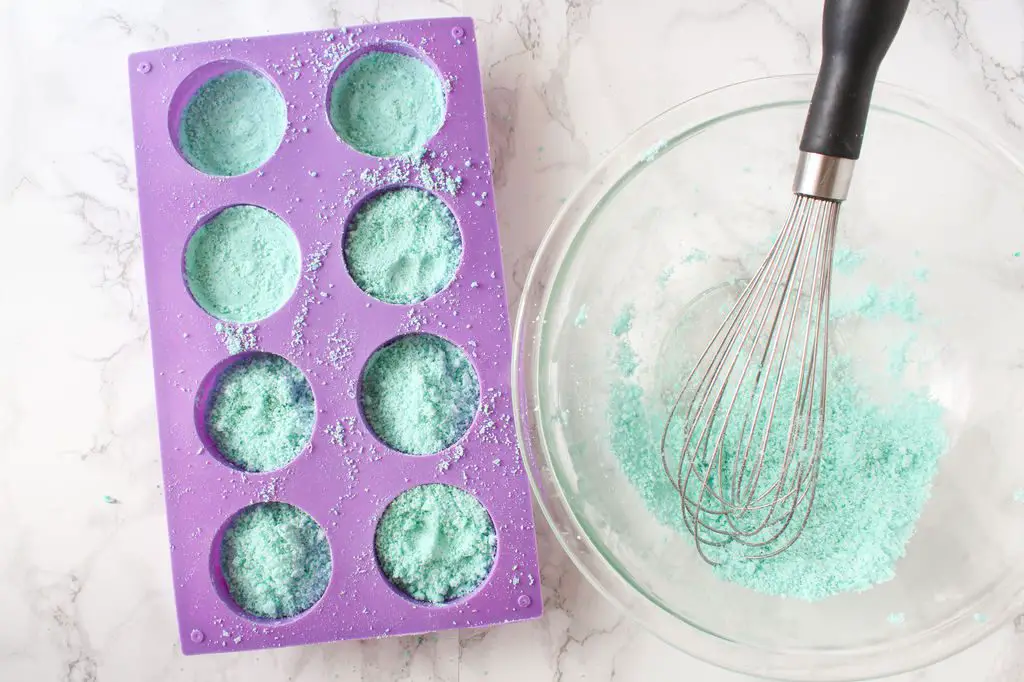
Use a silicone mold and pack the mix in extremely tightly. Add small amounts to the mold and pack it down with whatever you have around – use an essential oil bottle at first, and then a measuring cup to really push the mix down. If you don’t compact the bath bomb mix enough at this point, you’ll end up with bombs that crack and crumble when you release them from the mold.
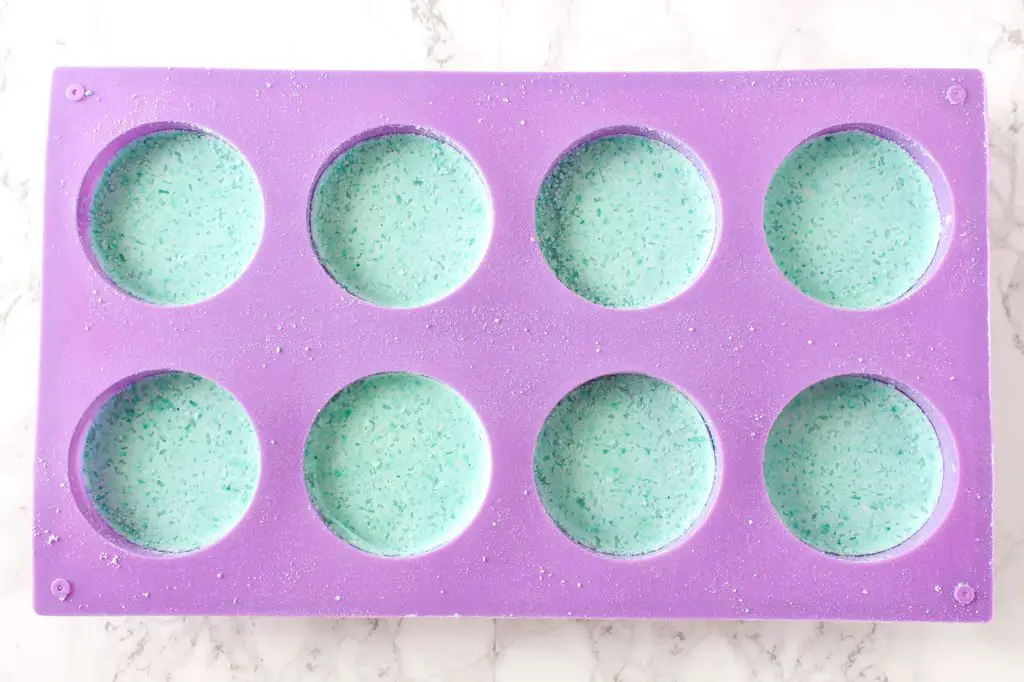
the completed moulds

Once your bath bombs are packed into the molds, you need to let them dry completely. For best results, let them sit overnight.
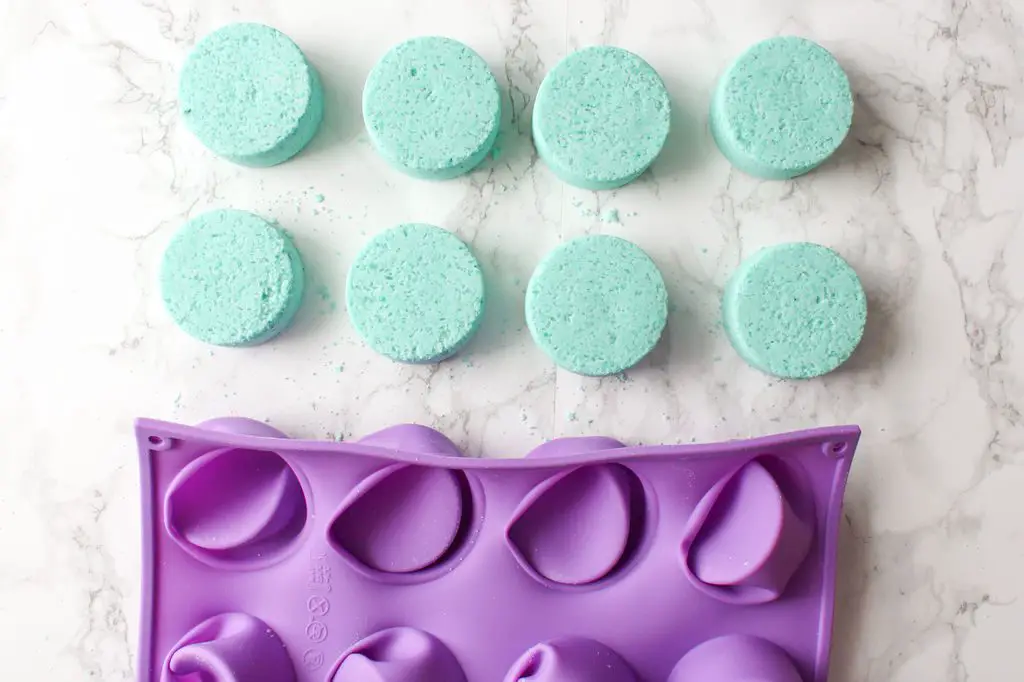
poping the bombs out of the moulds

When the bath bombs are still soft, you’ll be able to apply pressure with your finger and feel it sink in a bit. When the bombs are completely dry they’ll be hard as a rock!
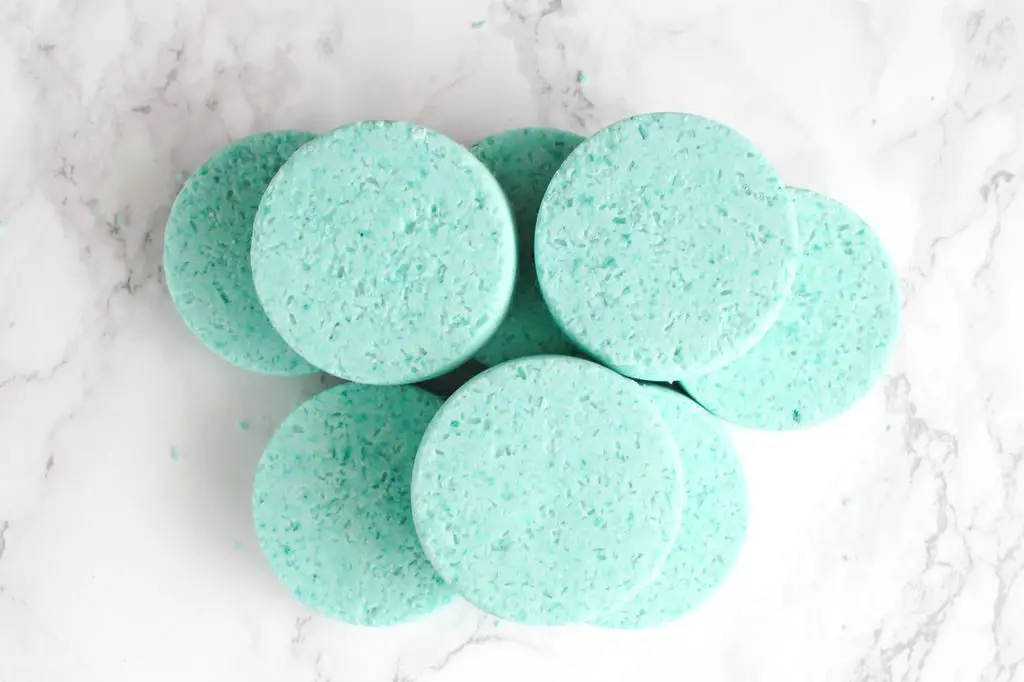
diy moisturising bath bombs 2

Once they’re dry, gently push them out of the molds.

Make sure to store your bath bombs away from moisture in an air tight container for best results.

Enjoy your bath bombs!

Why not plan a romantic stay at home spa evening for your partner and use these bath bombs as a little starting surprise gift?

This post was adapted from DIY Moisturizing Bath Bombs by jessyratfink and has been modified and used under the Creative Commons license CC BY NC SA.

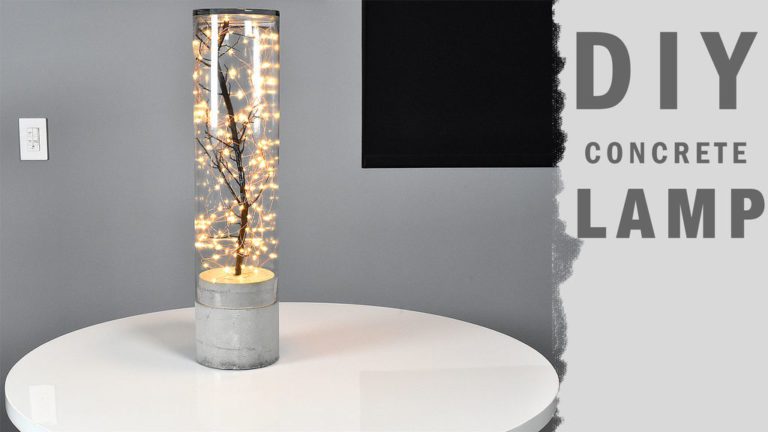
DIY Indoor And Outdoor Concrete Lamp

This LED concrete lamp looks amazing both indoors and outdoors. They provide the perfect amount of ambient light and can be colour and brightness controlled if you buy an LED string with a controller and remote. Make these as a gift for a friend or loved one and they are sure to be impressed with your DIY skills. This is the perfect weekend project and is great way to get started working with concrete.

If this project seems a bit too complicated and you’d still like to try out a project with concrete, have a look at our guide on making mini concrete planters.

What You’ll Need To Make A Concrete Lamp

How To Make The Concrete Lamp

The instructions are broken up into three sections, making the mould and casting the concrete base, preparing the tree branch and installing it on the base and finally installing the LED lights.

Making The Concrete Base

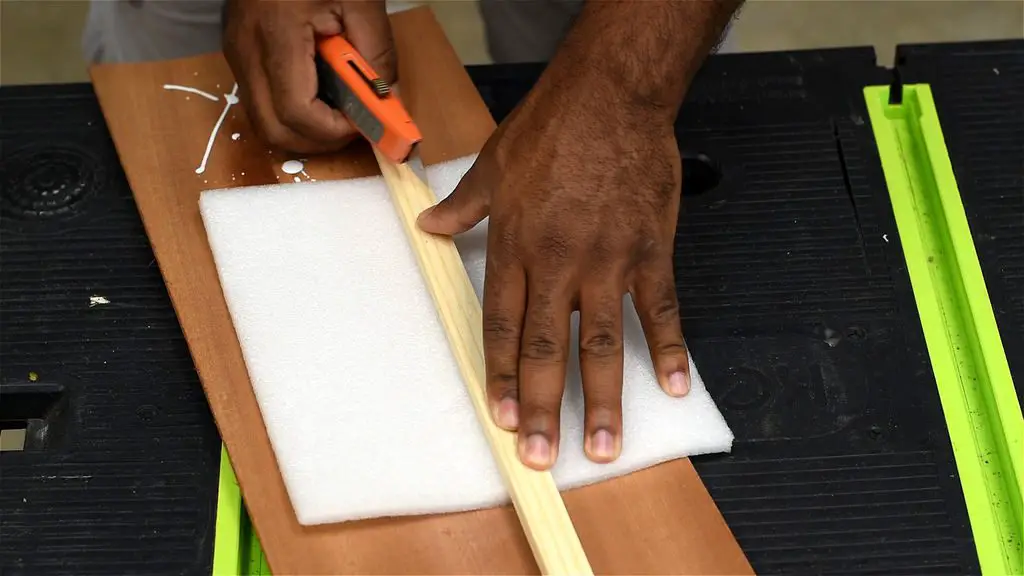
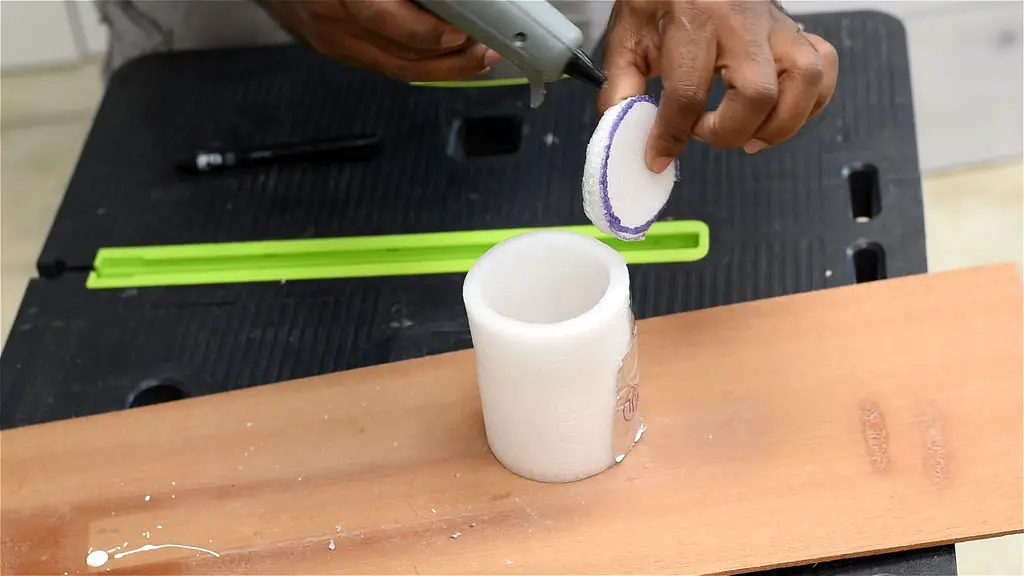
First you need to make the housing for the electronics for the LED string. Take a piece of foam from a shipping package and cut it to create a cylinder.

make the led storage container

Close it by taping the side and then cut out a circle to close off one end. A paper cup would work as well.

make the led storage container cylinder

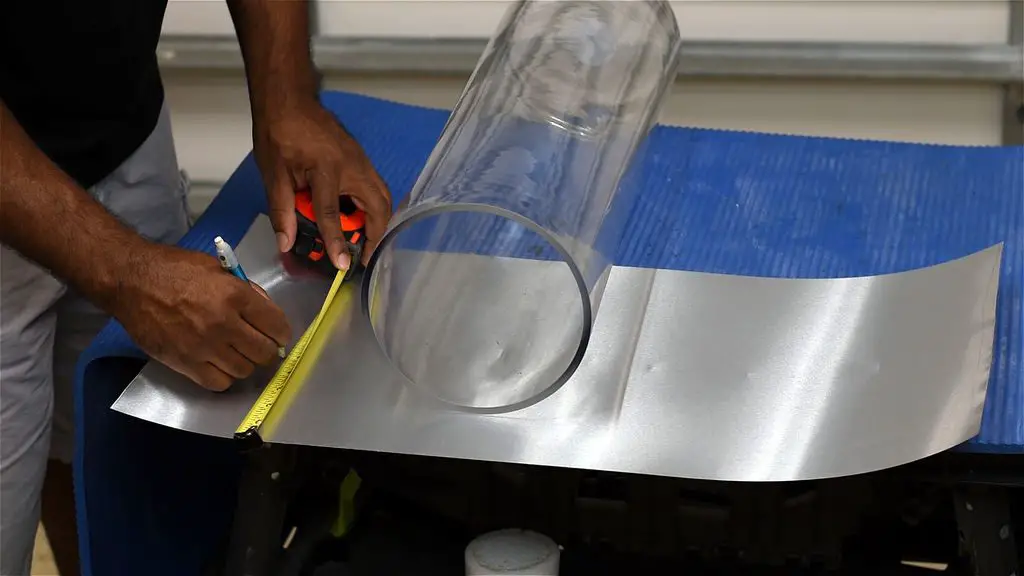
Now you need to make the outside of the concrete mould using a piece of metal flashing. First mark the metal flashing for the bottom of the form,  12 centimeters or 5 inches tall. Next, mark 5 centimeters or 2 inches above the first line. At this point, you will have two parallel lines.

make the concrete form mould

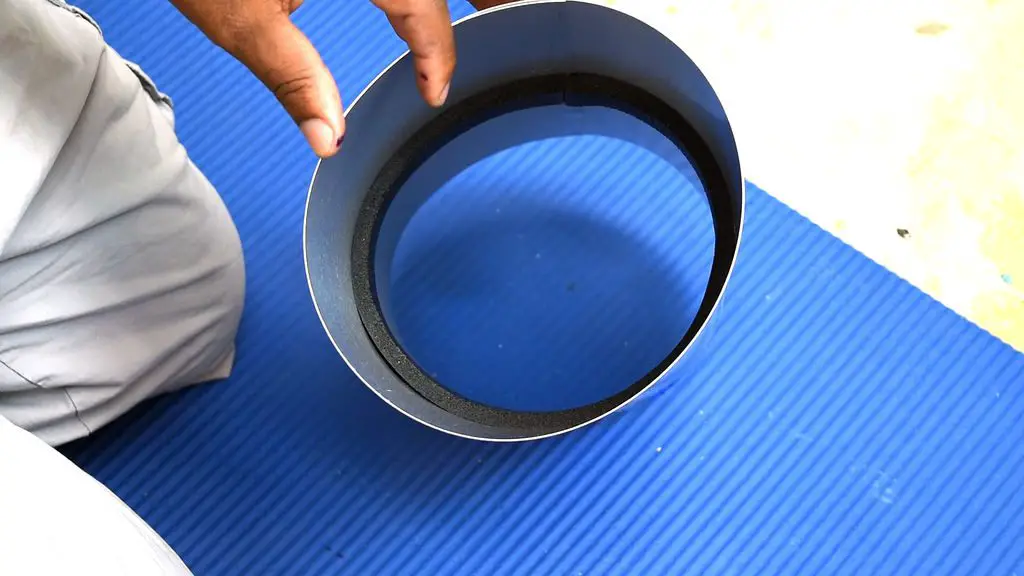
Now wrap the metal flashing around the vase. Close the flashing by taping the loose end. Next, take two 2.5 centimeter or 1 inch rubber seals and follow the line going around the interior. Do this twice to give yourself a two-inch path around the interior of the flashing. This part will shrink the interior, which will make the glass fit over the concrete base.

make the concrete form mould part 2

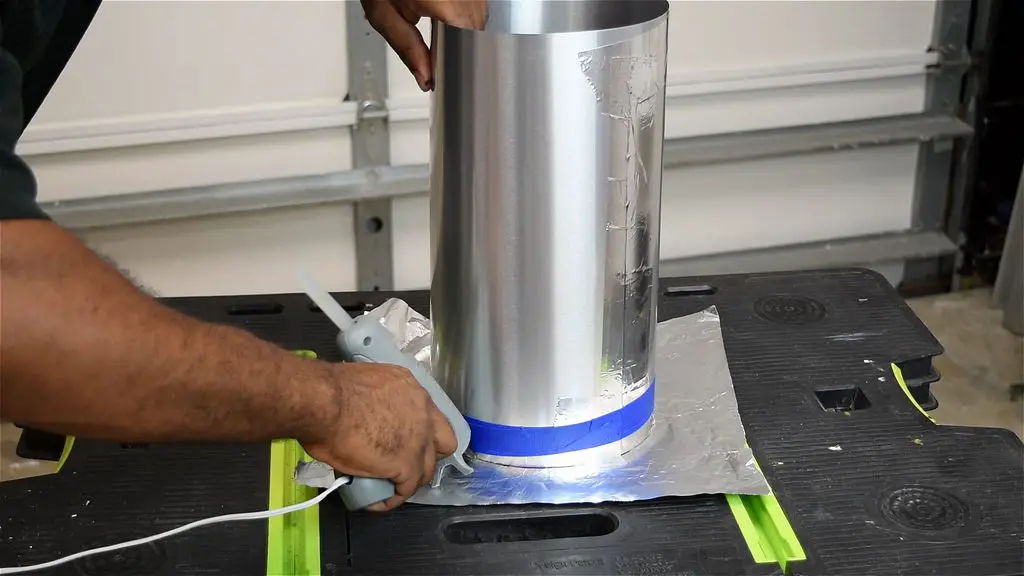
Take a piece of aluminum foil, place it down on a flat surface. Then trace the vase and then the foam cup as shown.

make the concrete form mould part 3

Use hot glue to secure the cup then the flashing to the marking.

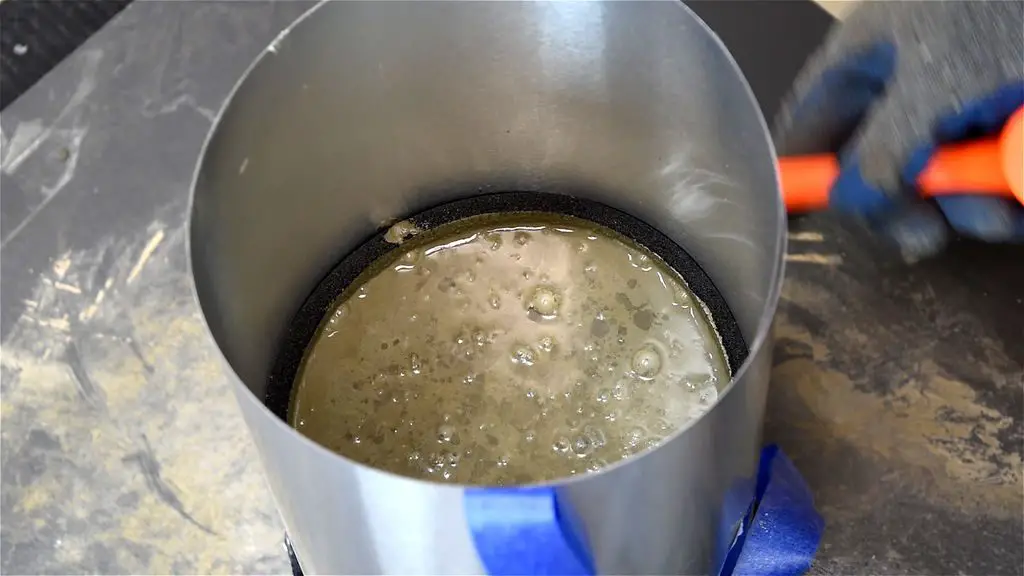
the complete concrete form mould

Mix concrete and pour it in the form.

casting the concrete form

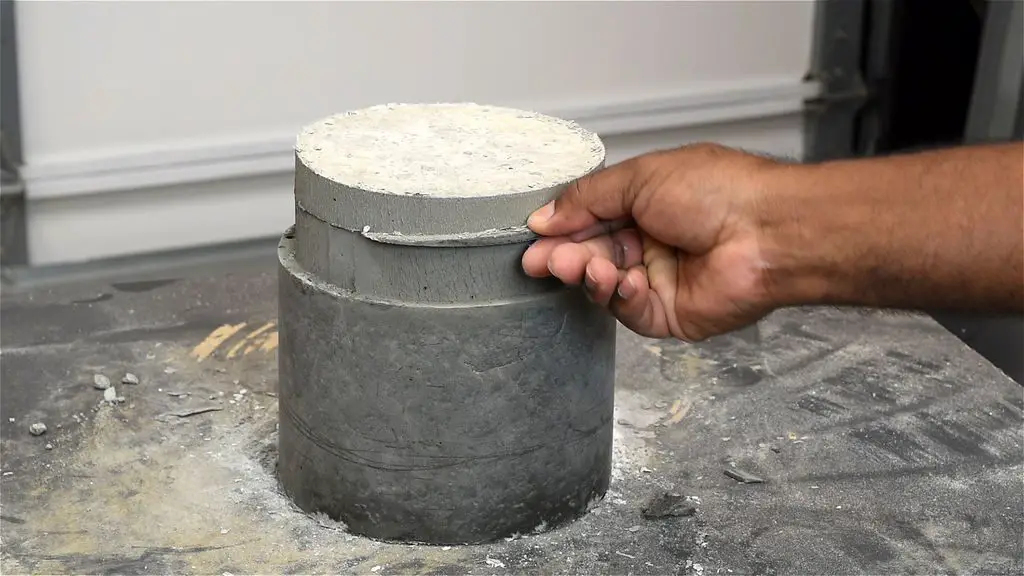
After a few days remove the flashing and rubber seal.

the final conrete form before cleaning up

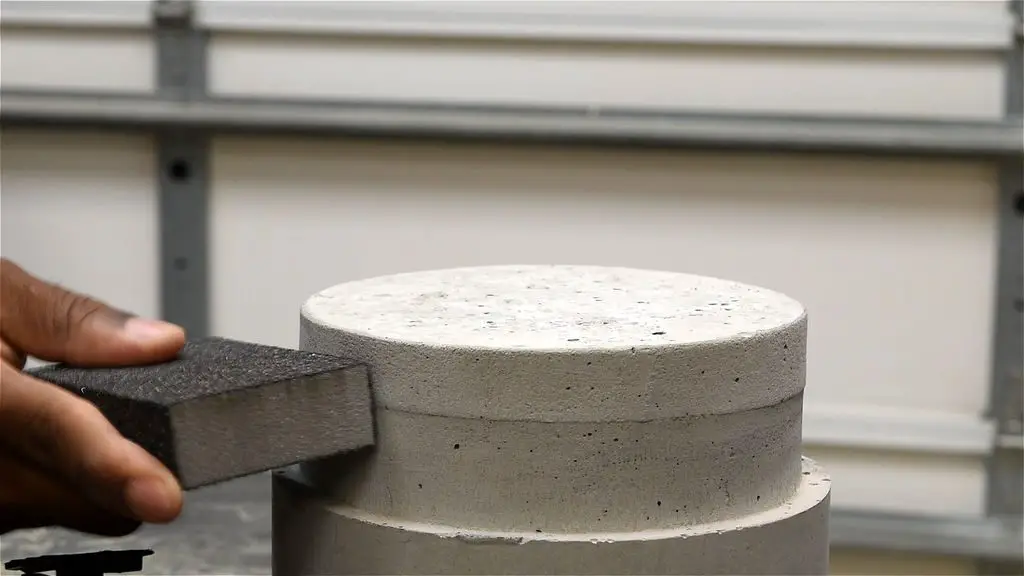
The bottom should be smooth but you will need to sand the top.

sanding the edges of the concrete

Preparing The Tree Branch

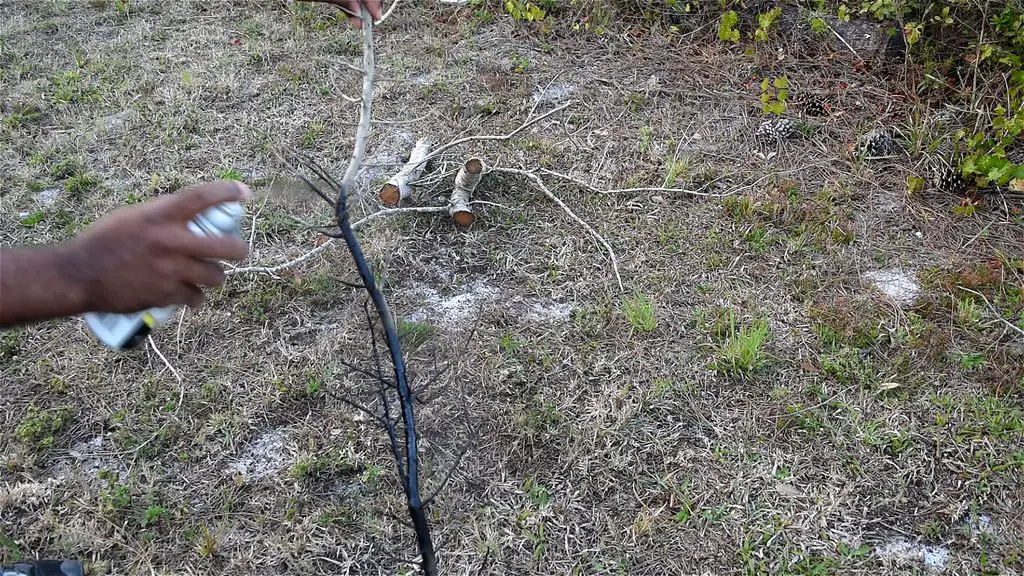
Choose a suitably size tree branch to fit into your vase, then spray it with black spray paint. Allow time to dry between coats until it is uniform and not blotchy.

spray the tree branch black

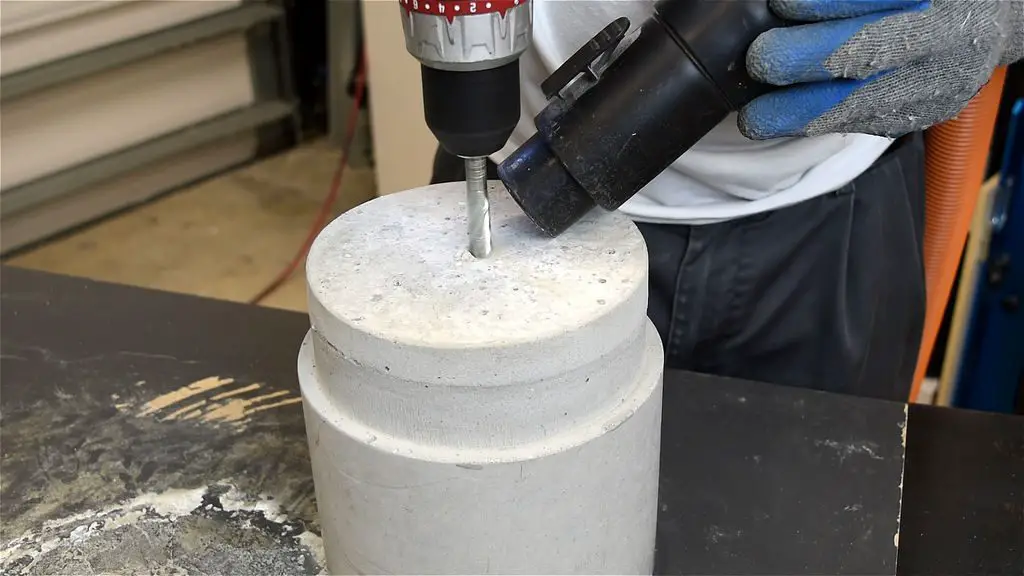
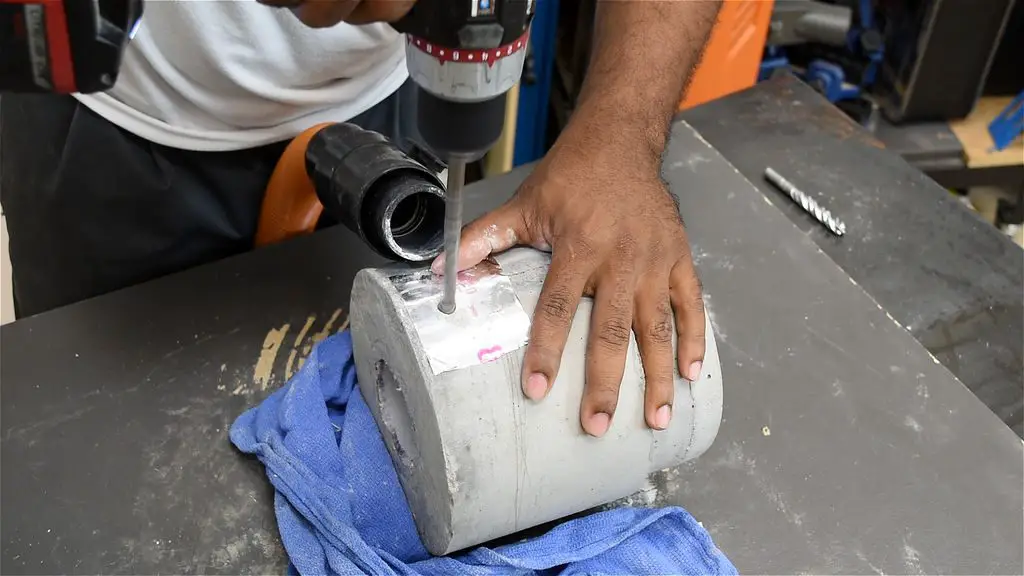
Depending on the size of tree branch you chose, use the appropriate size masonry bit to drill a hole for the branch into the concrete. A 12mm or 1/2 inch bit was used here to drill down into the foam cup.

drill a hole for the tree branch into the conrete

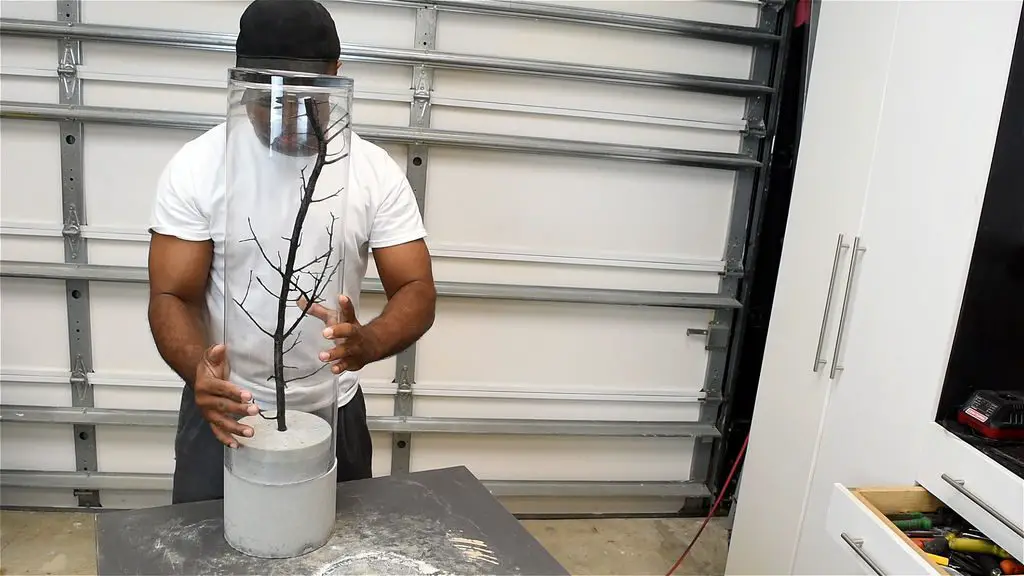
Test that everything fits nicely.

insert the tree branch and ensure that the glass vase fits over the branch

Install The LED Lights

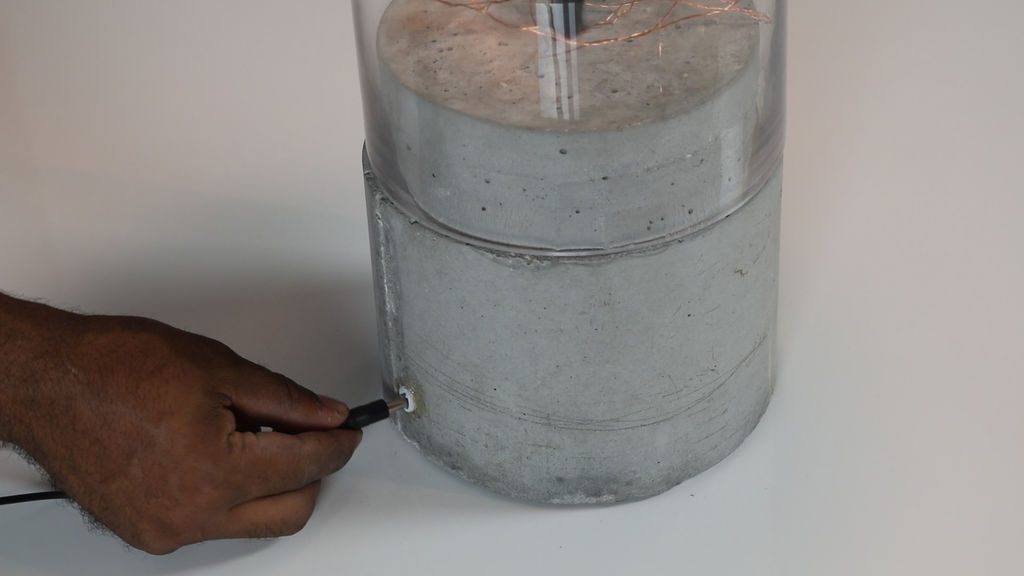
Drill a hole in the lower part of the concrete base for the LED power plug to pass through. Next, use hot glue to hold the plug in place.

drill a hole for the power cable for the led

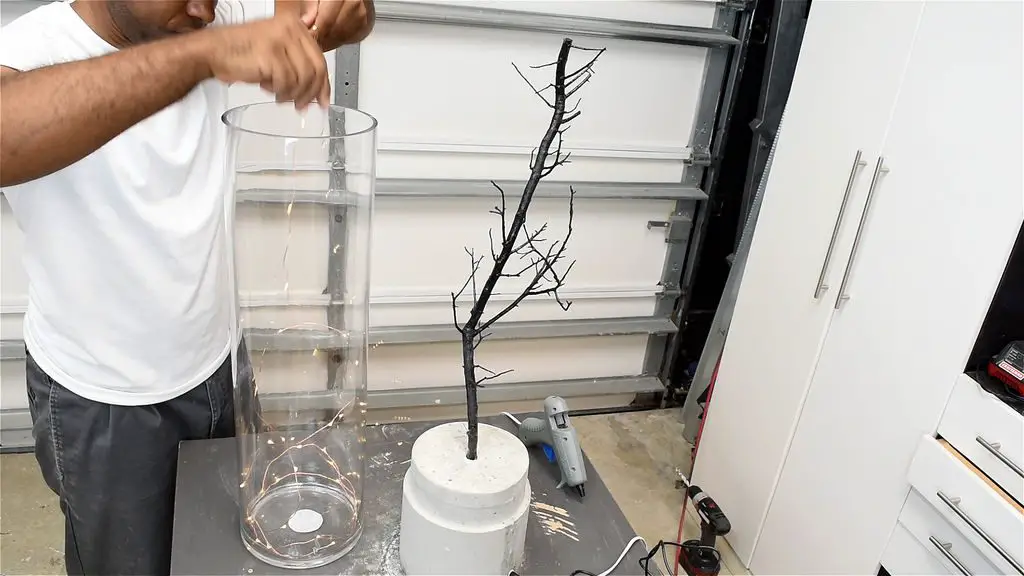
Pass the Led String light power end down through top then connect to the power cable.

Next, feed a few feet of the led into the vase.

add the led lights

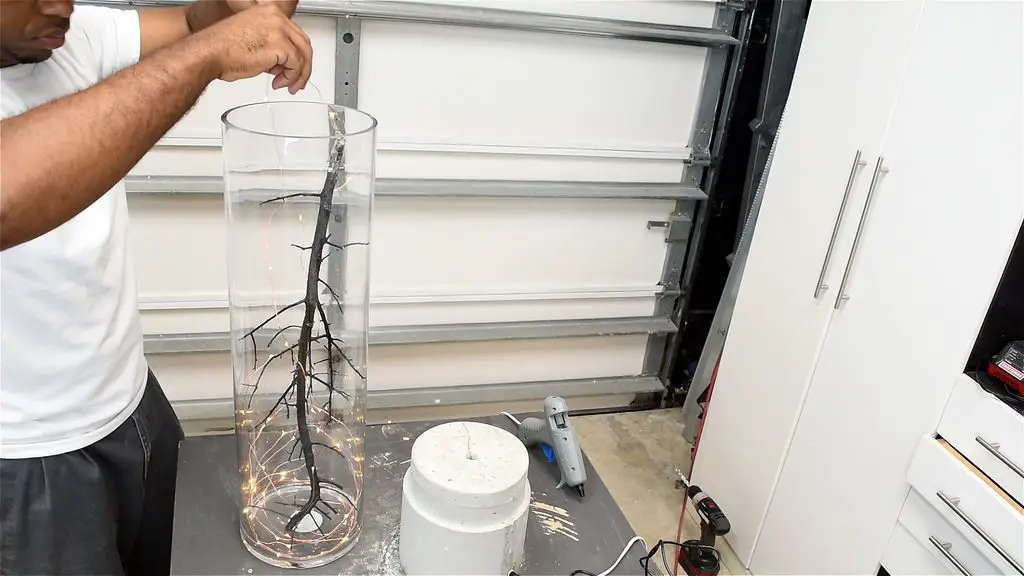
Then place the branch in the vase and feed more led as you proceed.

twist the lights around the branch

Now sit the vase on top of the concrete.

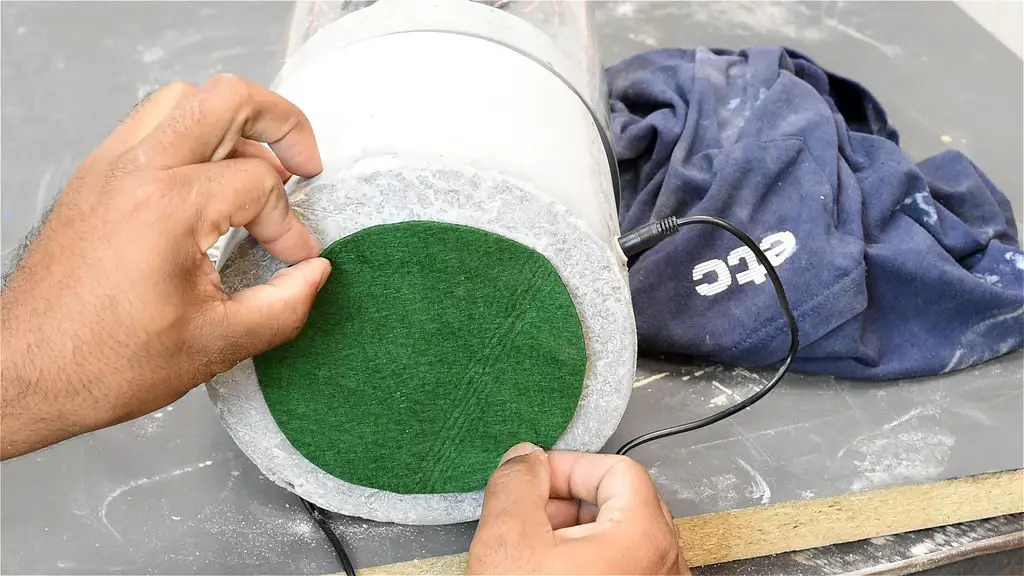
Cut out a felt pad and stick it onto the bottom to protect the surface it stands on as the concrete base is heavy and rough.

add felt to the bottom to stop it from scratch your furniture

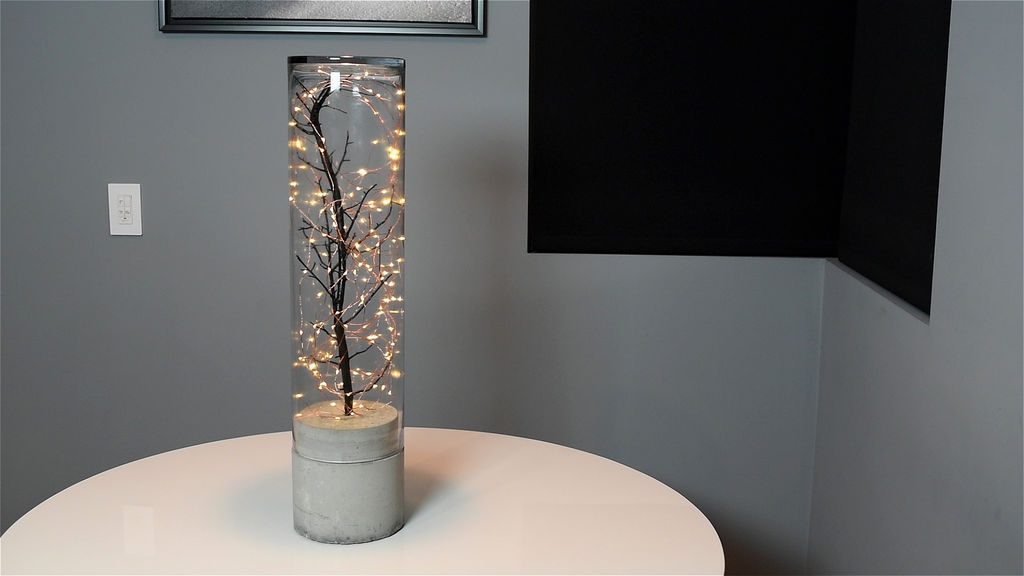
Your lamp is now completed and can be plugged in.

completed led light 3

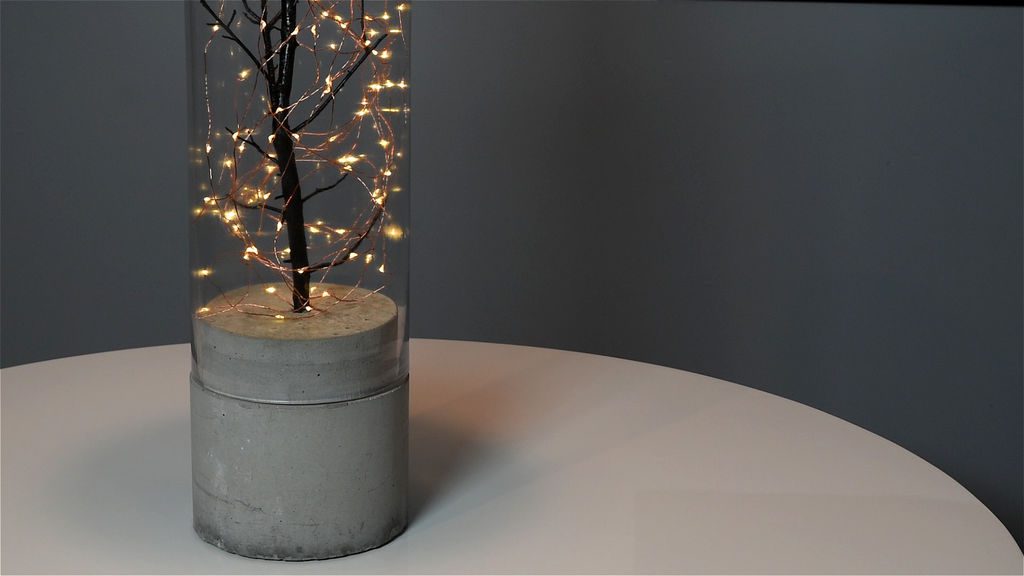
The Completed Lamp

completed led lightcompleted led light 2

This post is based upon DIY Indoor Outdoor Concrete Lamp 2 by diycreators and has been modified and used under the Creative Commons license CC-BY-NC-SA.

 

24 Tips On Becoming A Minimalist, Start Living The Simple Life

We tend to live an over complicated and certainly over cluttered life, here are 24 tips to get you started on decreasing your possessions and becoming a minimalist. It may be difficult to start with but you’ll soon find yourself feeling a little more liberated with each item you donate or sell. The best advice we can give is to take it slow, give yourself time to adjust to having less around the home, you’ll soon be wondering why you accumulated so much in the first place.

We’ve divided the list up into sections to make it easier to work through. Try to set a goal to knock one item off of each list each week, this way you’re giving yourself time to adjust and breaking the workload up.

Kitchen

  1. Throw out all your expired food. Go through your cupboard and your refrigerator and freezer and throw out all of your expired food. While you’re at it, throw out any food which your family isn’t going to eat.
  2. Get rid of cracked or chiped crockery. Chips in plates, mugs and dishes are a breeding ground for bacteria and look shabby.
  3. Don’t collect mugs. Mugs are often given out as gifts and freebies and we hoard them. Trim your mug collection down to a set of 10-12, you don’t really need any more than one per person and a few for guests.
  4. Donate your unused appliances. Everyone knows the story, we try out a juice diet or go vacuum sealer mad for a while but inevitably we land up with a cupboard full of unused appliances. Donate any you havent used in the last year.
  5. Throw out duplicates. You don’t need three knife blocks, four measuring jugs or two can openers. A minimalist only needs one of each.
  6. Throw out the broken things. As you’ve done with your broken crockery, get rid of broken knives, appliances etc.
  7. Invest in some good quality pots. This is the only items which includes buying something but it is for good reason. Get rid of your light aluminnium and teflon coated pots and pans and invest in about three stainless steel pots and two cast iron skillets.
  8. Organise your finances. This may be a strange inclusion here but the kitchen is often a dumping ground for bills, letters and payslips. Follow this guide to organsing your finances.

Bathrooms

  1. Throw out expired medicine. As you’ve done in the kitchen, throw out anything which has expired. Some areas require expired medicines to be disposed of through special programs, make sure to follow your local regulations.
  2. Cut down on toiletries. Go through your toiletries and throw out any products you don’t like using, including free samples and giveaways you’re never going to use. Go through your makeup while you’re busy.
  3. Donate your excess towels. You don’t need more than two towels per person, one for the bathroom and one clean one for the linen cupboard.
  4. Donate your unused appliances. Donate that old braider or curling iron you haven’t used in years.

Bedroom Closets

  1. Donate any clothing you haven’t worn in a year. If you haven’t worn it through a whole season. chances are you won’t wear it again.
  2. Sell anything that doesn’t fit. If it doesn’t fit you then there’s no point in keeping it.
  3. Cut down on clothing numbers. You may have a collection of t shirts or skirts which all fit you and aren’t too old but do you really need so many? Your minimalist closet shouldn’t contain more than 7 of any item.
  4. Toss any damaged clothing. If it’s got a rip or tear which you can’t see yourself fixing, throw it away or take it to be fixed immediately.
  5. Cut down on your shoe collection. You don’t need more than one of each type of shoe.
  6. Keep one weeks worth of underwear. Go through your underwear, including socks and pick out seven of each. Throw out all the old and worn out ones.

Living Room

  1. Stop using cable. Not much good comes from cable, you sit around wasting time and are fed hours of advertisements and rubbish. Stop using cable and switch to movies and a service like Netflix.
  2. Clean up your surface space. You may have one or two knick knacks which are sentimental but throw the rest out, they just gather dust and clutter surfaces, have a look at our guide on de-cluttering.
  3. Don’t keep a library. There really is no point to keeping a library of books, most are only read once. Donate them to your local library and you’ll still have access to them whenever you need it.
  4. Digitise your music and movie collection. Which the exception of vinyls, which are making a comeback. You should digitise all of your CDs and DVDs, you’ll save a whole cupboard and replace it with a single hard drive.

Kids Rooms

  1. Donate unused toys. If your kids haven’t used the toy in a month or so, get rid of it. Your kids grow up and toys become outdated and don’t stay age appropriate.
  2. Throw out the broken toys. Throw out any toys which are broken and can’t be immediately or easily fixed.
  3. Limited the stuffed animals. These seem to creep into any household and accumulate in numbers, limited each child to a few and make sure you donate the old ones often.

And that’s the list to get you started on becoming a minimalist. Print out this list and work through it over the next few months. You may also be interested in saving some money with a couple of tips on frugal living.

Do you have any other tips and tricks to becoming a minimalist? Let us know in the comments section below.

Share This Guide

24 Tips On Becoming A Minimalist, Start Living The Simple Life

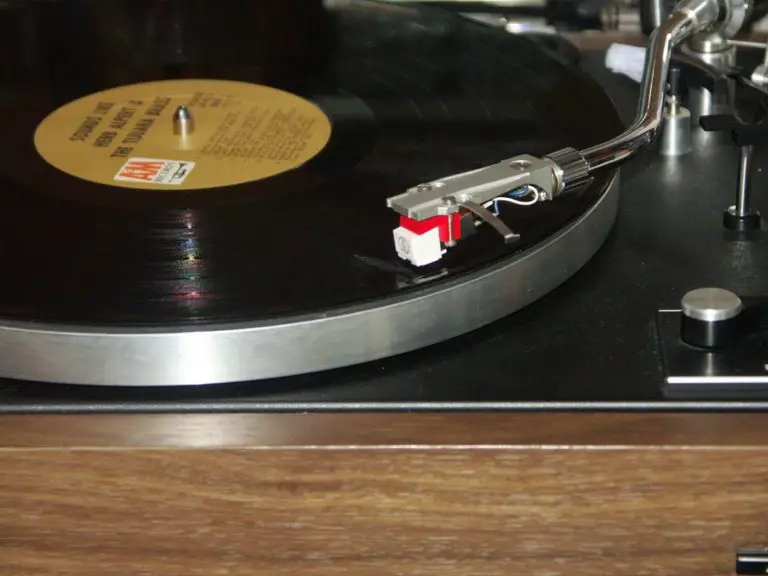
How To Deep Clean Your Old Vinyl Records – Reduce Background Noise

With vinyl records making a comeback, people are looking for ways to get their dusty collection clean and ready to use again. To ensure the best sound and least amount of wear on your records, it is essential that they are kept clean.

We’re got two methods here, one to give your records a full deep clean and another which is great for removing thin layers of dust and reducing the background noise.

Remember, the best cleaning in the world just removes all the dust and dirt. Some records will have scratches and groove wear. No amount of cleaning will fix this. So after cleaning, some record may sound “perfect” and others maybe not so much.

Giving Your Vinyl Records A Deep Clean

What You’ll Need

  • A Basin of some kind – Buy Here
  • Dish soap (any kind will work) – Buy Here
  • A record cleaning brush/pad (Discwasher style) – Buy Here
  • A few washcloths – Buy Here
  • A source of warm water
  • Towels to dry off the records

Cleaning The Vinyl Records

small amount of dish soap

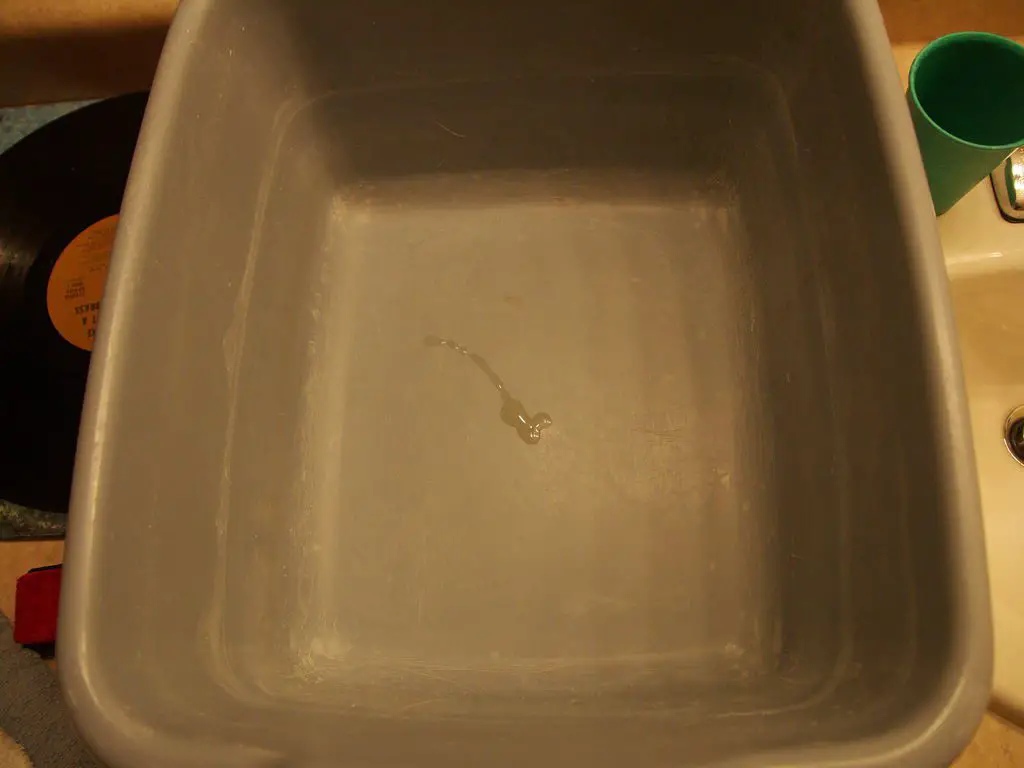
Put an extremely small about of soap in the basin, and then fill it with about 3-4″ of warm water. Stir up the soap by swirling it around with your hand while filling up the basin. Now place the basin on a counter top or other comfortable surface where cleaning your records.

washing the records

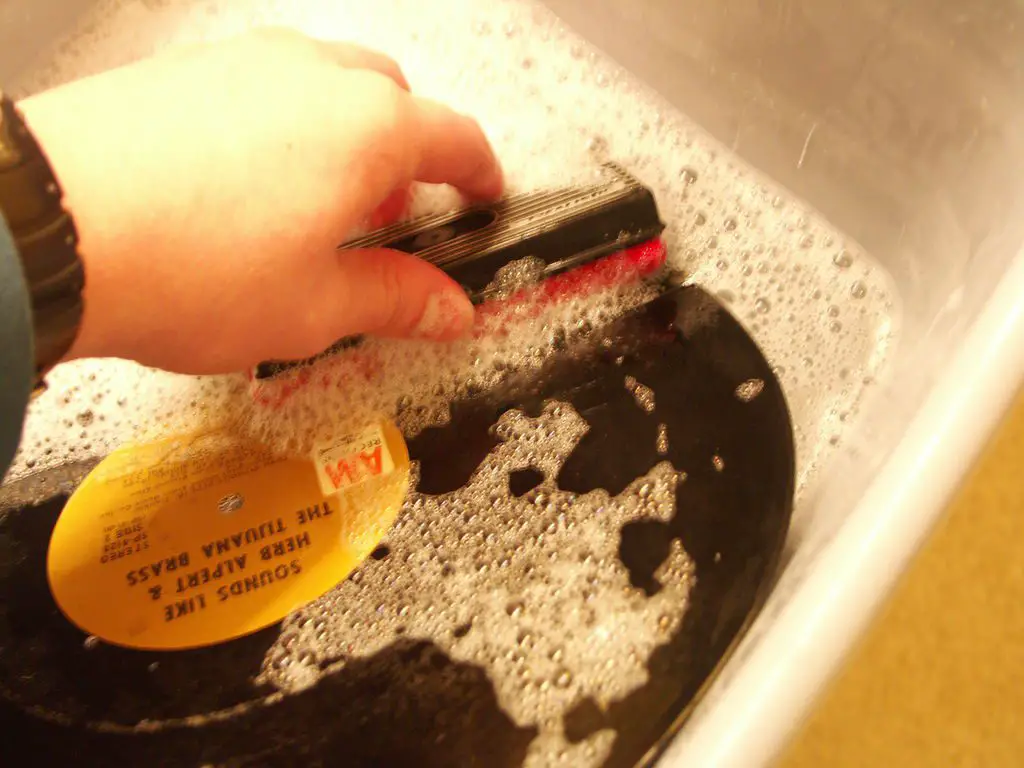
Put a record in the basin, and turn it around by moving the edge with the palms of your hands (as to not touch the grooves).
Once the whole surface of the record is wet, grab the record brush and get it wet. With one hand, hold the record (with your palm) and with the other, move the brush in a circular motion about 10 times. Try to do 5 counter-clockwise and 5 clockwise turns. If you’ve got heavy grime, you might want to do more.. After one side is clean, flip it over and repeat.

rinsing the records

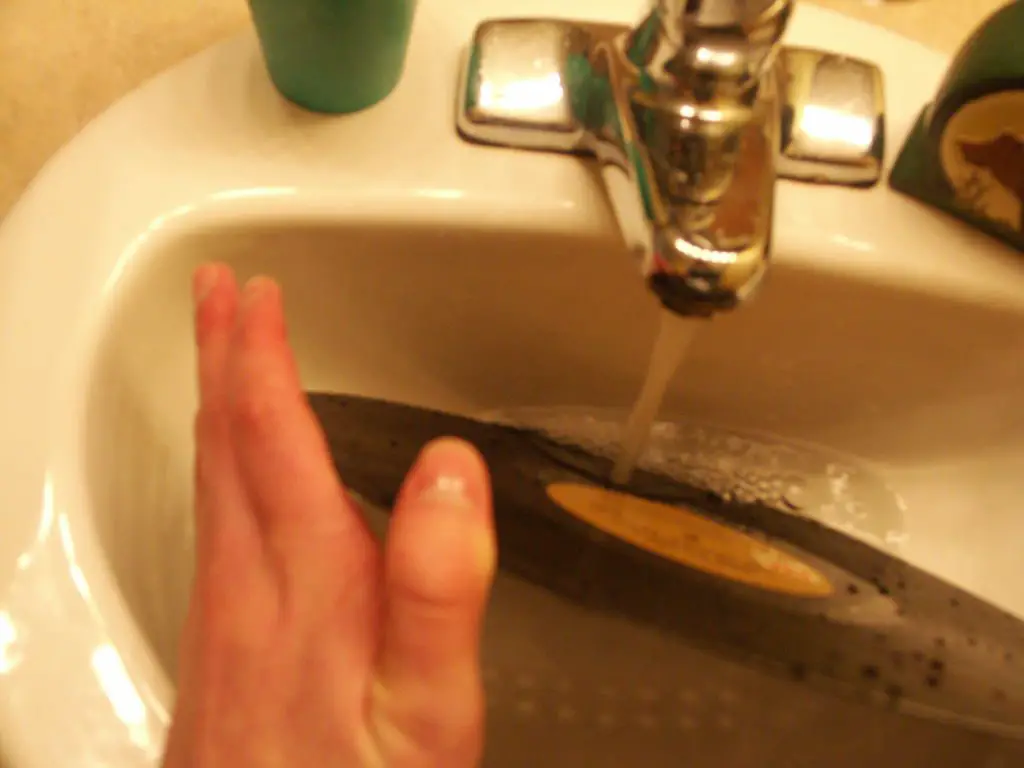
After you’ve gotten the record clean, put it in a sink and run some cold water over it, and turn the record with the palms of your hand. After one side is clean, flip it over and do the other. Once it’s clean, turn off the tap and let the water run off.

drying the records

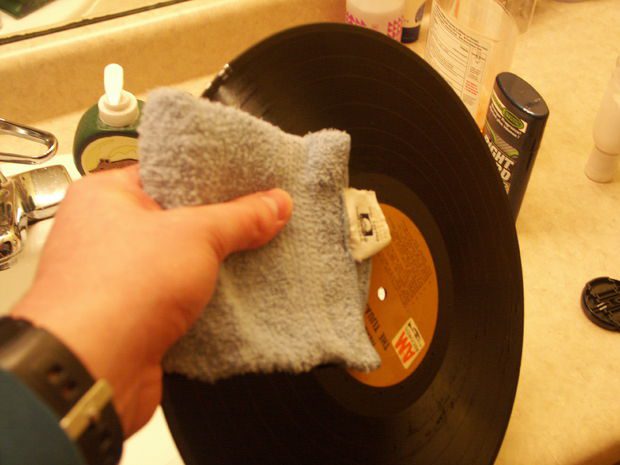
Now that most of the water has run off, put a wash cloth in your hand, and grab the record with it. Now put another washcloth in the other hand, and grab the record. With one had, hold the record, and with the other, dry it off. Once it’s dry, flip it over and do the other side (which should be most dry by now). Once the record surface is dry, put the washcloths on the labels and press against them with your hand. This should get the labels dry. After the record is mostly dry, set it on top of it’s cardboard sleeve, then place it somewhere and let it dry for several hours.

Giving Your Vinyl Records A Quick Clean And Reducing Background Noise

This is the second method we have used to clean vinyl records and it works well for lighter dust and dirt, the WD40 also lubricates the tracks, reduces friction, wear and background noise.

What You Need

  • WD40 specialist anti friction Dry PTFE Lubricant – Buy Here
  • Microfiber Dusting Cloth – Buy Here

How To Clean The Records

Squirt four small amounts equally spaced on the on the center of the tracks and clean in a circular motion with a soft microfiber cloth. You will notice the cloth will collect dirt so change to a new part of the cloth every few turns. Keep polishing until all trace of liquid has disappeared and the record is shiny black, the record will feel very slippery.

If the record is in reasonable condition background noises will be reduced. On the first play more dirt will pop out of the grooves after which it will stay clean for while with less static. This trick even reduces record wear as the WD40 reduces friction between the stylus and the record track.

Share This Guide

How to deep clean your old vinyl records and reduce background noise

This post is based on Cleaning Vinyl Records by mattdp and has been modified and used under the Creative Commons license CC-BY-NC-SA.
Try A Creative Resume To Land Your Dream Job

With the number of job applicants increasing significantly over the last few years, you need to do something to stand out from the crowd. According to GoResume.com, old traditional resumes will be out of style in the near future, and using a more modern resume is fast becoming the norm. So make the change and try out a creative resume template while there’s still a chance for you to stand out from the competition and be different.
What Is A Creative Resume Template?

A creative template is one which differs from the traditional, some might say “boring”, plain white format. A creative template generally makes use of some colour, icons, layout variations and different fonts in order to catch the eye of the recruiter.

Here Are Some Examples On Offer From Go-Resume:

You Only Have 6 Seconds To Impress

Recent studies have shown that good resumes grab the attention of the recruiter within the first 6 seconds. It is therefore important to have an eye-catching and professional resume. If you were given hundreds of boring white versions and only ONE visually appealing one, which one would you remember?

You Need Call Backs

Before worrying about attending an interview, you need to get invited for one. More and more individuals don’t put enough effort in this crucial aspect of the application process and send out numerous applications. A modern resume template for Adobe Illustrator and Microsoft Word will help you get noticed, this means call backs and interview invitations.

Go Resume has a range of templates in both eps format for editing in Adobe Illustrator and docx format for editing in Microsoft Word, many of which are mobile device friendly and can be edited right from your phone or tablet.

So make the switch today and try a creative template. You’ll be surprised by the results!

Remove Hard Water Stains with this DIY Epsom Salt Scrub

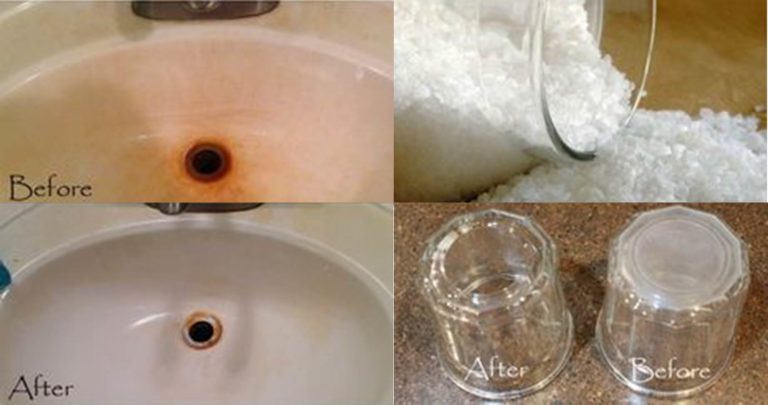
If you’ve got glass shower doors or tiles that show every hard water stain in your bathroom, then you understand the constant frustration of keeping everything looking clean. Hard water stains make things look dingy — even when they’re not. Stop scouring with harsh chemicals and attack hard water stains with eco-friendly Epsom salt that leave your shower sparkling. Think of it as an exfoliating scrub for your bath!

If you’ve got tile in your tub or glass shower doors that show each and every hard water stain, here’s a simple Epsom salt scrub that will make things sparkle.

What You Need To Make The Epsom Salt Scrub

How To Make The Epsom Salt Scrub

Put all of the ingredients together in a mixing bowl and blend them together well. Don’t use an electric mixer as you don’t want to break up the salt or baking soda granules, they assist with scouring.

To remove hard water stains, cover the stain in the mixture and then srub the stain gently with a soft scouring pad or a brush. Allow the salts to do the work, you don’t need to apply too much pressure to work the stain away. Within a few seconds you should already see a significant reduction in the size of the stain and it should be completely gone in a minute or so.

For harder stains, scrub for a few seconds and then allow the mixture to sit on the stain for two to five minutes before scrubbing again. This allows some time for the salts to work on the stain.

Do you have any tips and tricks for removing hard water stains around your kitchen and bathrooms? Let us know in the comments section below.

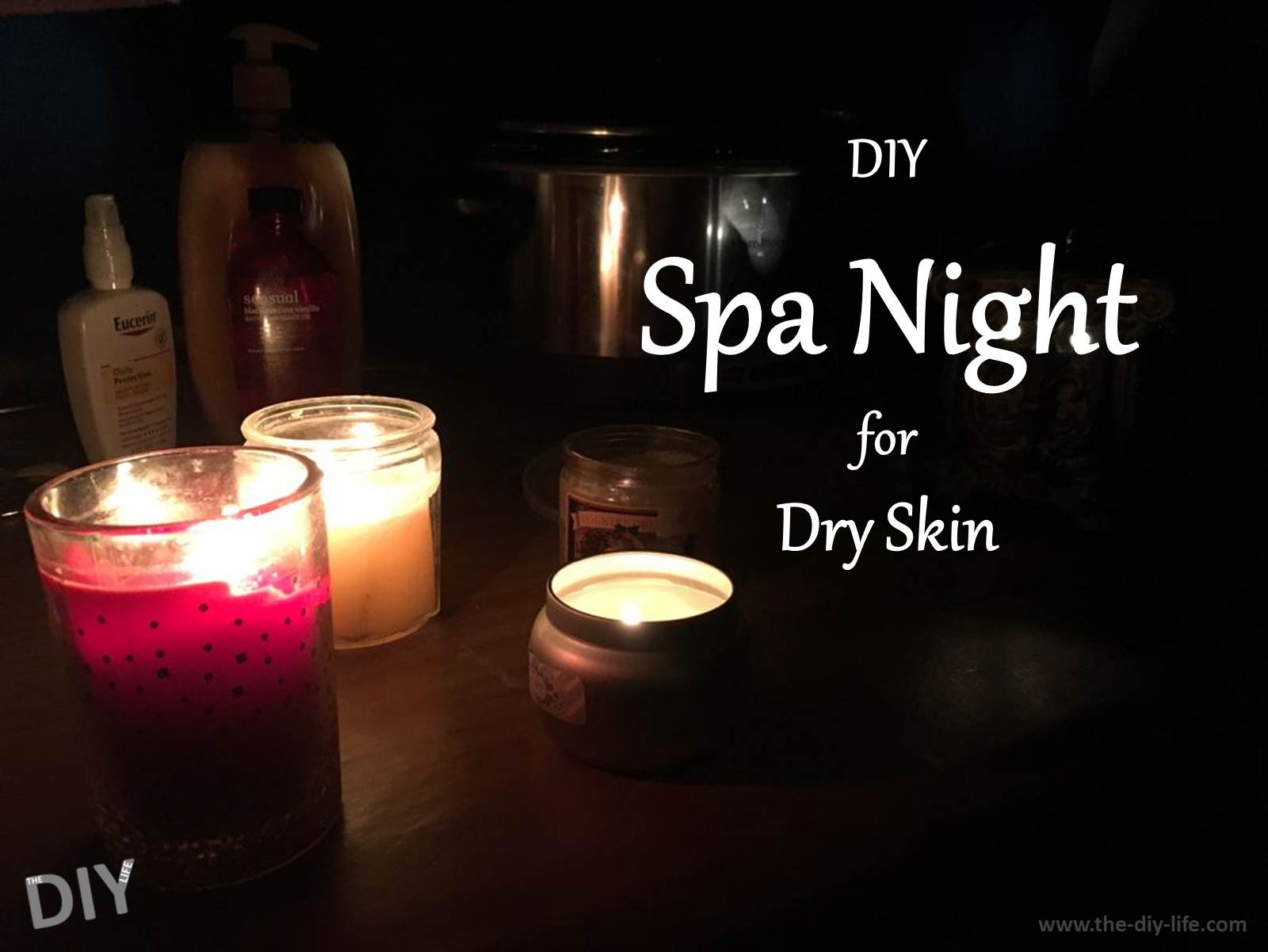
DIY Spa Night for Dry Skin, the Perfect Pamper Evening

0

Do you feel like you need to take an evening off to relax and rejuvenate your dry skin? Or treat your partner to a romantic evening by putting this spa evening together for her/him. This guide uses objects you find around the house to produce an at-home spa for another person. While most of the items you’ll need are commonly found around the home, we’ll provide a comprehensive list of items to prepare before you begin the spa experience.

Setting the Scene

setting the scene

Right before the spa, relax and prepare a relaxing environment.

  1. Invite your friend or partner to take a relaxing shower or wash his/her face, hands, and arms with warm water.
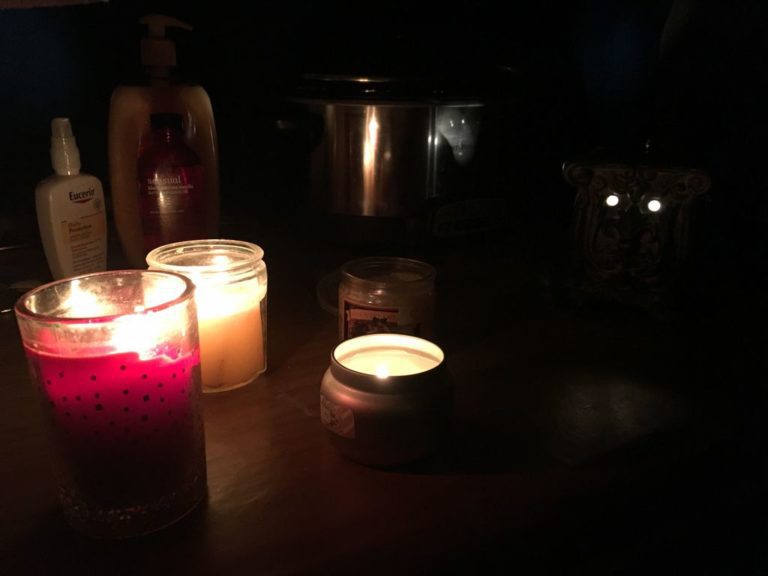
  2. Make sure there are no harsh or bright lights in the room. Light the room with a lamp or candles. Avoid overhead lights since your friend will spend time with his/her face towards the ceiling.
  3. Use a comfortable area. A reclining armchair is ideal, but a couch or a bed could work, too. Ensure that your friend is comfortable before beginning the spa treatment.
  4. Set the mood with comfortable audio. Play soft, calming music during the entirety of the spa. If the music’s audio is less than 30 minutes, then plan a playlist beforehand so DJ needs do not interrupt your work.

This will be a two-part spa. It will involve a facial and a foot treatment. The entire foot treatment could happen during step 11 of the facial. Read over all the instructions before beginning the spa treatment to make sure you have everything ready when it’s needed.

Spa Facial Ingredients

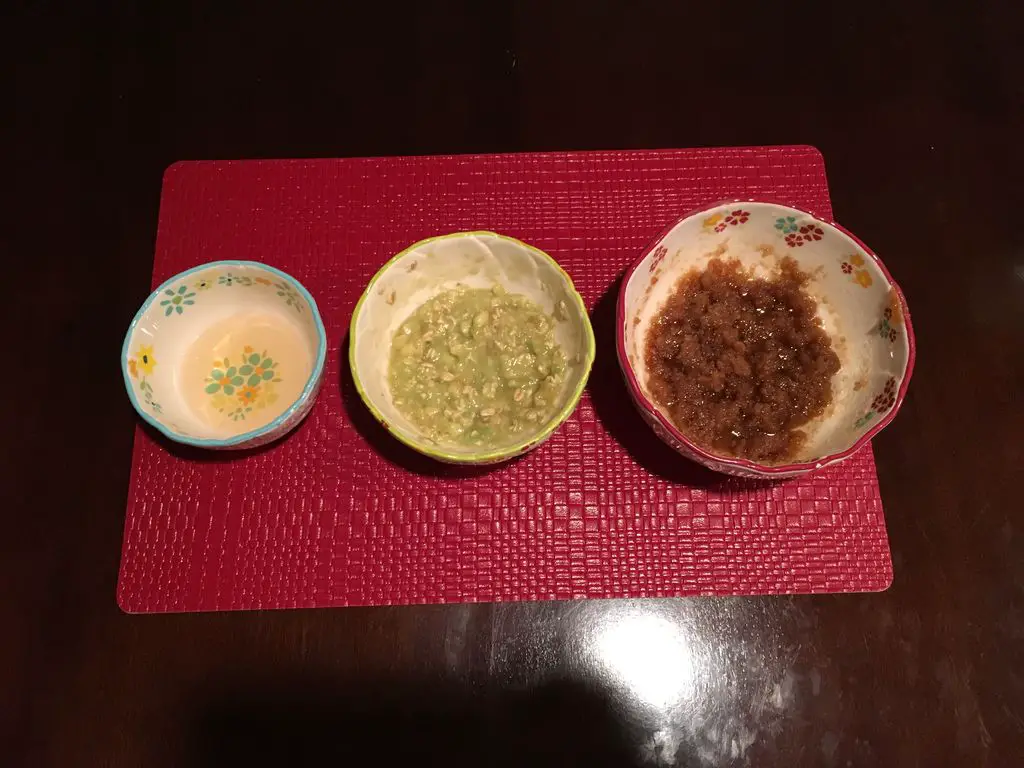
facial ingredients

[From left to right: toner, facial, and body scrub. Body scrub recipe and directions not included in this tutorial.]

You will need:

  • 1/2 ripe avocado
  • 1/4 cup of plain whole oats (not “quick oats”)
  • washcloth towel face cleanser (any kind; a bar soap or liquid cleanser is okay)
  • hot-to-boiling water
  • 1 tablespoon apple cider vinegar
  • cotton balls or pads (optional)
  • table or breakfast tray

How To Do The Facial

facial steps

At-home facials are quick, easy, and inexpensive. Natural foods are full of moisturizing properties to soothe your dry, tired skin. Avocados and oatmeal are popular bases for DIY facials for dry skin. This recipe combines the two for a simple, relaxing experience.

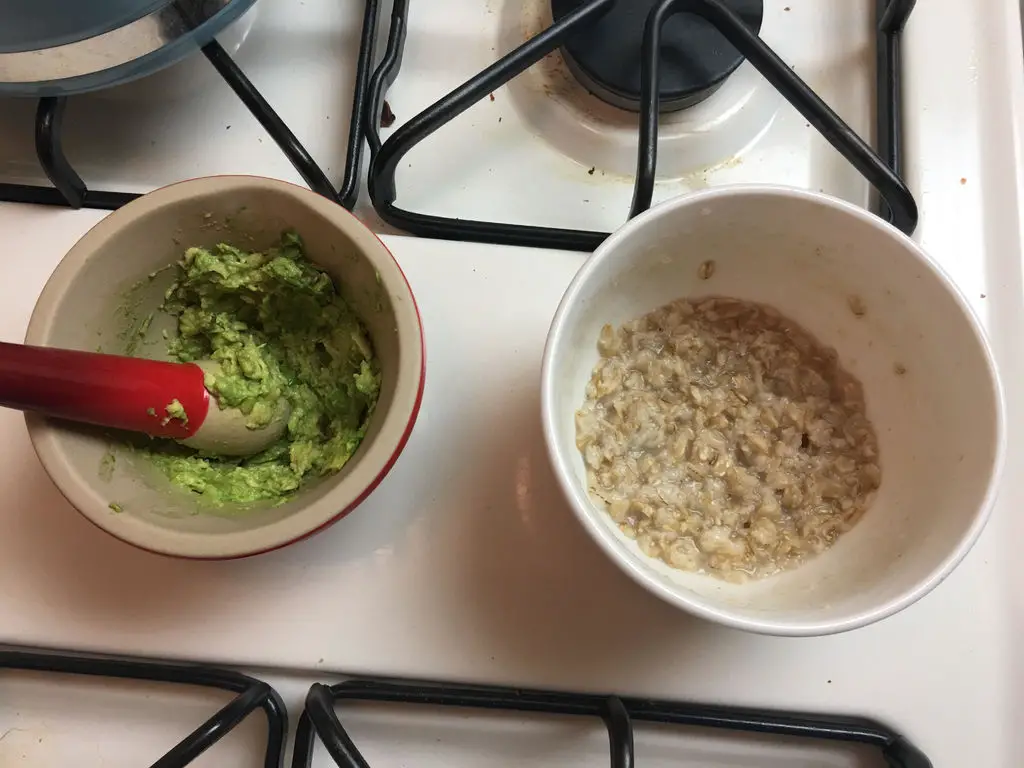
  1. Prepare the oatmeal. Put 1/4 cup of plain whole oats (any kind but quick oats) in a microwave-safe bowl. Add 1/2 cup of water. Microwave for 1 minute. The oatmeal should be soft and mushy; if it isn’t, cook it for 30 seconds and repeat until soft.
  2. Prepare the avocado by removing the skin and the pit. Set aside the half you don’t plan to use.
  3. Mash the avocado in a bowl until smooth. Add the oatmeal into the bowl and stir with a spoon until the mixture is an even texture.
  4. Boil about 8 cups of water in a large pot. This may take anywhere from 10 to 20 minutes depending on your stove.
  5. While the water is boiling, have your friend wash his/her face with warm water (NOT the boiling water) and a face cleanser.
  6. Pour the boiling water into a bowl. The bowl could be on a table and your friend could be on a chair at the table. Alternatively, if you have a breakfast tray, your friend could sit on a couch or a recliner and set the bowl of boiling water on the tray.
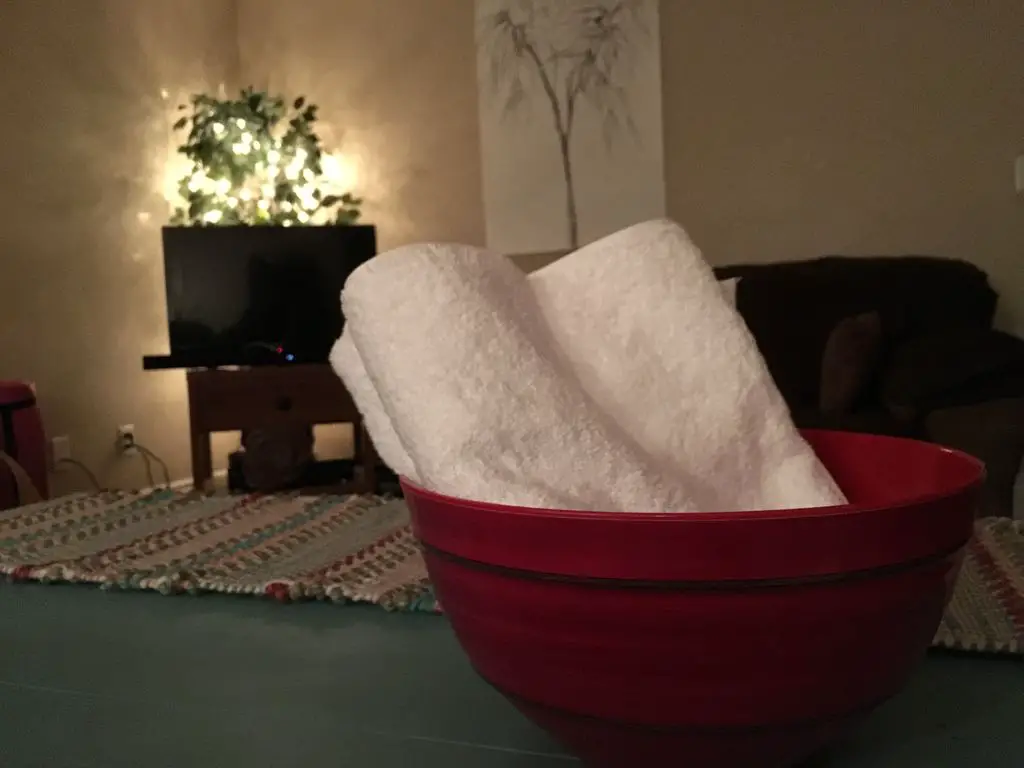
  7. Have your friend hover over the steaming bowl with a towel over his/her head. Drape the towel over the head like a tent, forming an enclosed shelter around the head and shoulders. He/she should breathe the steam in for 5 to 10 minutes, removing and replacing the towel for fresh air as needed.
  8. Have your friend lean back into a comfortable reclining position and set the bowl of hot water aside.
  9. Pat his/her face with the towel.
  10. Apply the facial. Spread the avocado-oatmeal mixture evenly all over your friend’s face, being careful to avoid the eyes. You may not use all of the facial; this is okay. Make sure that the skin is covered.
  11. Let the facial sit for 15 minutes or until it hardens. If it is still wet and goopy after 15 minutes, fan your friend’s face or invite your friend to pace the room to dry the facial.
  12. Wash the facial off your friend’s face with warm water and a washcloth (if he/she is more comfortable doing it alone, encourage him/her to use the washcloth). You will probably want to do this in a sink with a garbage disposal or a strainer.
  13. Have your friend rinse his/her face with warm water.
  14. While your friend is rinsing off, prepare the toner by mixing 1 tablespoon apple cider vinegar with 1 tablespoon water.
  15. Splash your friend’s face with cold water.
  16. Apply the toner over your friend’s face with small patting motions, avoiding the eyes. It will help if you use cotton pads or balls, but it isn’t necessary.
  17. Apply your usual facial cream or lotion quickly.

Spa Pedicure and Foot Treatment Ingredients

Prepare beforehand:

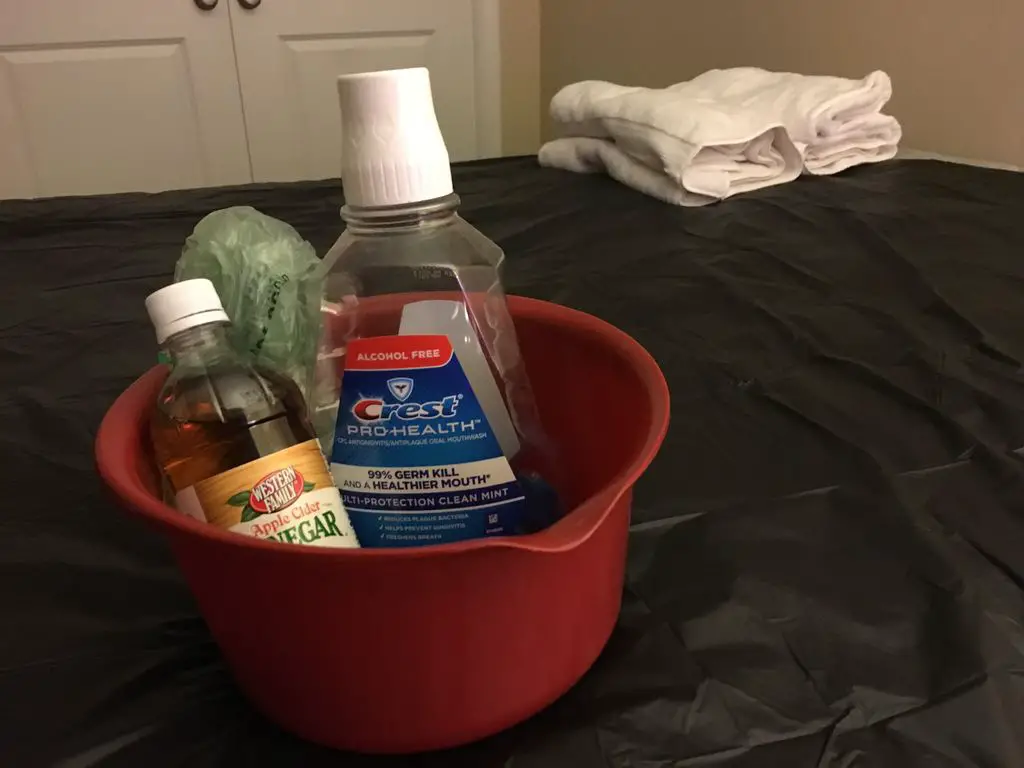
  • 1 cup of mouthwash
  • 1 cup of vinegar
  • 2 cups of warm water
  • Foot file or pumice stone
  • Dried herbs (optional; for scent only. Consider lavender, eucalyptus leaves, mint, or basil)
  • Towel
  • Nail clippers
  • Nail file
  • Lotion

How To Do The Pedicure & Foot Treatment

pedicure and foot treatement

(You could do this while the facial is sitting.)

  1. Combine mouthwash, vinegar, and water in a bowl large enough to fit your feet in. Sprinkle in dried herbs for a comforting scent.
  2. Let the feet soak for 10 minutes.
  3. Pat your friend’s feet dry.
  4. Scrub dry patches of feet with foot file or pumice stone over a towel. This will remove the dried skin that the food bath has loosened. Make sure you communicate with your friend to ensure that he/she is comfortable and the filing does not hurt.
  5. Clip your friend’s lunula (the white, crescent, excess part of the toenail) over the towel. File down any rough or jagged edges.
  6. Spread lotion across your friend’s feet and rub it in. Consider incorporating motions from this video on foot massages as you rub the lotion into the skin.

Your spa evening is now complete.

Do you have any other inclusions for your own home spa days? What are some of your homemade treatments? Let us know in the comments section below.

Share This Guide

DIY Spa Night for Dry Skin

This post is based on DIY Spa Night for Dry Skin by 410R MBS Group and has been used and modified under the Creative Commons license CC-BY-NC-SA.

How To Clean Your House In Under 2 Hours

Keeping your house clean may be a struggle. Here are some tips to help keep it manageable, you only need to run through this list once or twice a week to keep your house clean. Well most of the time at least! This list helps keep your cleaning manageable so it never feels overwhelming.

Let’s get started…

P.S. These London cleaners can clean your house even faster

Bedding & Laundry

If dong the laundry is going to form part of your cleaning tasks then you’ll want to get it started so that your washing machine can do the work while you’ll doing the cleaning. Go around the house and collect all of the bedding and dirty laundry, towels etc. Refresh your bed by sprinkling some essential oils and baking soda onto the mattress to freshen it up, leave it to absorb any dirt and moisture while you’re cleaning the rest of the house.

Take all of your collected laundry and stick it into the washing machine, check the time so you know when to switch loads or take the clean laundry out of the machine and put it into the dryer. While you’re busy with appliances, put all of the dirty dishes into the dishwasher and run it as well, you’ll now have your dishwasher and washing machine working for you while you clean the rest of the house. If you haven’t quite filled up a load of dishes, have a look at these other items which you can put into the dishwasher to clean.

Tidy Up And Dust

Now grab your empty laundry basket and move from room to room collecting anything that doesn’t below in that room and moving it to its correct place. Do this with a dusting cloth and some dusting spray, give all of the counters and surfaces a wipe down as you go through each room. Also tidy up as you go to make sure everything looks nice.

Clean The Bathrooms & Kitchen

Once you’re done tidying up, move onto the bathrooms. Grab a bucket with some warm soapy water and a cloth and start wiping down the walls, mirrors, cabinets and counters. Throw a fizz ball or some toilet cleaner into the toilet, when you start cleaning the bathroom and it’ll be done working when you’re finished. If you’ve got a spare set of towels, hang these up now so that you can simply pack the cleaned ones away when the laundry is complete.

clean bathrooms and kitchen
Bathroom by Brett Jordan

Move on to the kitchen when you’re done with the bathrooms, clean all of the counters, cabinets, surfaces and the sink. Wipe the front and sides of your appliances and tidy up anything which is out of place.

Sweep & Mop The Floors

Sweep the dirt on the floors into neat piles which can be vacuumed up in the next step. You can also sweep the dirt onto a carpet in each room, it’ll be vacuumed up soon. Now take a floor cleaner or mop and mop the floors to remove and dirty patches.

Vacuum The Carpets

Get the vacuum cleaner out and vacuum the carpets, also remember to collect the dirt piles you made when you were sweeping. If you’ve sprinkled baking soda and essential oils onto your mattresses, vacuum that up while you’re in each room.

Finish Off Your Cleaning

All that’s left to do now is to grab the laundry out the dryer, fold it and put it away. Make any beds which you took the linen off of and replace any towels you removed from the bathrooms. Finally, unload the dishwasher, pack all the dishes away and you’re done.

What are some of the things you do to keep your home clean? Do you have a cleaning routine? Let us know in the comments section below.

Cover Image: new pillows and rug by tifotter. All images in this post are used under CC BY 2.0.

40 Frugal Tips To Save Money On Living Expenses

Think how much money you would save if you packed your own lunch and made your own coffee to go this week? What is you car pooled as well? One of these tips may save you $5, two or three may save you up to $100 a week and soon you’ll be well on your way to paying off your debts or going on a family vacation. Here are 40 ways you can save money on your living expenses.

  1. Use the cash only envelope system
  2. Ride your bike, walk or use public transport
  3. Do your own repairs
  4. Sell stuff you don’t use
  5. Don’t buy stuff to impress people
  6. Cut up old shirts and use them for cleaning rags
  7. Purchased used, vintage furniture instead of new furniture
  8. Compost your food waste
  9. Shop local
  10. Use coupons when you grocery shop
  11. Install low flow toilets and shower heads
  12. Buy energy efficient appliances
  13. DIY your gifts
  14. Plan staycation holidays
  15. Plan your errand to save time and gas
  16. Buy cheaper cuts of meat or opt for meatless meals
  17. Freeze your leftover vegetables to use in soups and bone broths
  18. Eat more beans and rice dishes
  19. Cut down on the electronic use, unplug and enjoy family time
  20. Drink more water and less pop and juice
  21. Run your washing machine and dishwasher only when full
  22. Run your washing machine on the cold water cycle
  23. Turn off lights that aren’t being used
  24. Cancel your landline telephone
  25. Fix leaky faucets
  26. Ditch your single use paper and plastic items
  27. Save your coins in a jar
  28. Stop using the pay as you go apps on your phones
  29. Unplug appliances that aren’t being used
  30. Turn the heat down and save on electricity
  31. Buy bulk, divide and freeze
  32. Cook from scratch
  33. Pack a bag lunch
  34. Plan an eat what you have meal plan for the week
  35. Ensure your furnace and hot water tank are maintained
  36. Weatherstrip the windows and doors
  37. Learn to say no
  38. Only fill the bath 1/2 full for bathtime
  39. Learn to use household tools
  40. Replace all your light bulbs with LED bulbs

Do you have any other tips for saving money on living expenses? Let us know in the comments section below.